
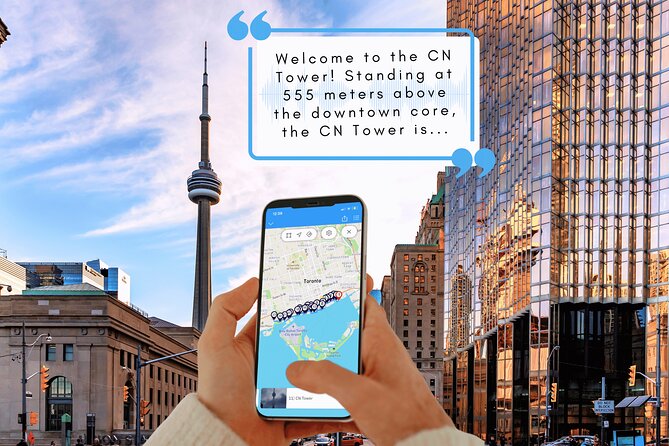
REVIEW · TORONTO WALKING & FOOD TOURS
Toronto’s Waterfront: a Smartphone Audio Walking Tour
Toronto’s waterfront tells a story if you listen. This smartphone audio walking tour guides you along the lakeside sights at your own speed, with commentary that plays when you reach each spot. It’s a simple way to connect Toronto’s big landmarks to the city behind them, from the CN Tower area to Princes’ Gates.
I especially like the live GPS map that keeps you oriented, plus the built-in location trivia game that turns casual walking into a little challenge. One thing to consider: some headline attractions on the route are sighted from outside, but admission is not included for the CN Tower and Rogers Centre, so you’ll need separate plans if you want to go inside.
In This Review
- Key points before you start
- A waterfront walk that keeps moving, without keeping time
- Price and what you actually get for $8.21
- Starting at Sugar Beach, the best place to get oriented
- Lower Jarvis Street to Redpath Sugar, industrial Toronto in plain view
- One Yonge Street and the Toronto Star Building, where media meets skyline
- Jack Layton statue to York Street views, civic landmarks you can actually spot
- The Power Plant and Simcoe WaveDeck, art you can walk on
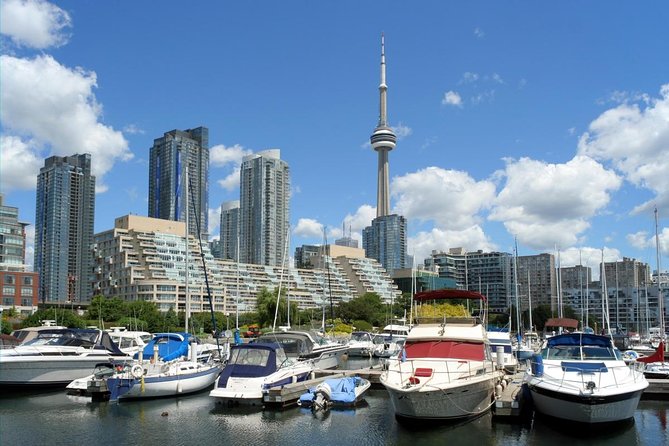
- CN Tower and Rogers Centre, iconic exteriors plus the ticket question
- HTO Park, Spadina Avenue, and the Music Garden, greener than you expect
- Billy Bishop views, Little Norway Crescent, and the waterfront trail rhythm
- Navy history and the Martin Goodman Trail, a long walk with a purpose
- Ending at Princes’ Gates, the perfect finish line
- Who this tour suits best (and who should skip it)
- Should you book the Toronto Waterfront Smartphone Audio Tour?
- FAQ
- Where does the Toronto Waterfront smartphone audio tour start and end?
- How long does the tour take?
- Is this a group tour or can I do it privately?
- Do I need cell service or data during the walk?
- Does the tour include entrance tickets for the CN Tower and Rogers Centre?
- Do I need headphones?
- What language is the tour available in?
- Is the tour accessible without a time slot?
- Is the tour available all day?
Key points before you start
- Self-guided, not a crowded group tour, so you can pause for photos or keep moving.
- Live GPS that moves with you, with audio starting automatically as you get close.
- A trivia game that’s tied to locations, so you’re not just listening, you’re guessing.
- A strong first-timer route, packed with waterfront highlights in a short walk.
- Free stops most of the way, with only a couple major indoor attractions requiring tickets.
More of Toronto covered on foot and by fork
- Toronto’s International Food Tour – Kensington Market★ 5.0 · 786 reviews
- Toronto: St Lawrence Market Food Tour with 6 Food Tastings★ 5.0 · 685 reviews
- Toronto’s First Food Tour: Taste the World in Kensington Market★ 5.0 · 526 reviews
- Downtown Toronto Bike Tour★ 5.0 · 336 reviews
A waterfront walk that keeps moving, without keeping time
Toronto’s waterfront is made for walking, but it can be overwhelming if you don’t know what to look for. This tour helps you sort it out fast, because each stop has a clear theme and a short audio segment. The pace is built for real life. You can stop whenever you want, then resume when you’re ready.
The timing info suggests about 45 minutes to 1 hour 30 minutes, depending on how often you linger. The itinerary segments are described as about 5 minutes each, but the tour itself is designed with no time constraints. That matters because Toronto weather and crowds can swing your pace. With an audio tour, you control the rhythm.
It’s also a smart option if you’re the type who likes understanding places before you take the next photo. You’ll get context for what you’re seeing, without paying for a full guided-group format.
Price and what you actually get for $8.21

At $8.21 per person, you’re paying mainly for the audio experience and the guided walking structure. That’s good value if you would otherwise spend time figuring things out on your own. In particular, the tour includes route support (the live GPS map), plus short guide commentary at each point.
Also pay attention to what is not included. The CN Tower and Rogers Centre are on the route, but their admission is not included. That’s normal for walking tours, and it’s useful to know ahead of time. If those two are your must-dos, you’ll likely want to pair this audio walk with a separate ticket plan for the indoor experience.
A small but practical note: the audio is designed to work from your phone, and headphones are optional. That can be a plus if you like to share your attention with the surroundings instead of wearing gear the whole time. On busy paths, though, you may prefer headphones for clearer audio.
Starting at Sugar Beach, the best place to get oriented
The tour starts at Sugar Beach, in the St Lawrence-East Bayfront area. This is a strong first move because it immediately frames the waterfront as more than a view. You begin with lakeside scenery, plus city elements and nearby attractions that set the theme for the walk.
From here, you’ll also pick up how the tour works in practice. As you walk, the live GPS shows where you are and where to go next. When you get close to a stop, the commentary is set to play. That means you don’t have to keep checking a screen to stay on track.
If you like the idea of a calm warm-up before the bigger landmarks, Sugar Beach is a good opener. You’re not jumping straight into crowds at a major ticketed site. You’re learning the lay of the land first.
Toronto at walking pace, a few more routes
Lower Jarvis Street to Redpath Sugar, industrial Toronto in plain view
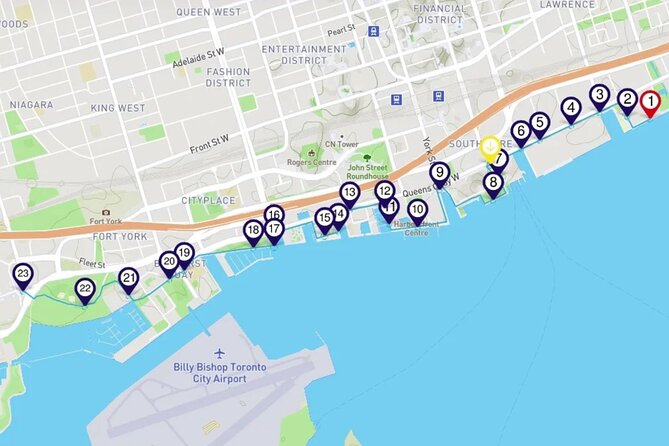
Next up is Lower Jarvis Street & Queens Quay East. This section focuses on Toronto’s industrial past and explains why that industry mattered to the city’s development. On this stretch, the waterfront starts to feel like a working edge of town, not just a postcard.
Then you hit Redpath Sugar Toronto, an iconic waterfront factory. The audio there gives you the background so the building isn’t just a photo stop. You’re meant to notice what industrial waterfront architecture says about the city’s growth.
A potential drawback here is also a reality of the waterfront. If you’re expecting constant jaw-dropping landmarks every minute, some industrial stretches can feel more textured than dramatic. The upside is that this tour gives you context, so even the in-between blocks make sense.
One Yonge Street and the Toronto Star Building, where media meets skyline

The tour shifts into downtown texture at One Yonge Street, with commentary tied to the Toronto Star Building and its long-time newspaper connection. Even if you’re not a media history nerd, it’s a helpful reminder that many famous city buildings were built for practical work first, glamour second.
You’ll then move to Yonge Street & Queens Quay West. The highlight here is the street’s Guinness World Record for longest road. It’s the kind of tidbit that’s easy to miss while walking, but it adds a fun layer to what you’re seeing.
This segment is also useful because you start recognizing patterns in Toronto. You see how the waterfront lines up with major roads, how the skyline rises above the lakeside path, and how the city’s grid meets the water.
Jack Layton statue to York Street views, civic landmarks you can actually spot

At Statue of Jack Layton, the tour points out the memorial area and the accompanying Jack Layton Ferry Terminal connection. This stop is a reminder that Toronto’s waterfront also functions as civic space, not only scenic space.
Then you reach York Street & Queens Quay West. Here the audio aims at a good view of the island. It’s a classic waterfront payoff. You stop, look out, and suddenly the route feels bigger because you can see where the city leads.
If you’re short on time on your first visit, this stretch helps. It gives you a few meaningful city anchors without dragging you into long detours.
The Power Plant and Simcoe WaveDeck, art you can walk on

One of the more interesting stops is The Power Plant. The tour has you looking at the Contemporary Art Gallery and explains why you might want to visit. Even when you don’t go inside, it gives you a reason to notice the building and its role in the neighborhood.
Next is Simcoe WaveDeck, where the audio focuses on the art you can walk on and the mind-boggling effect of the design. This stop is short, but it’s memorable. It turns a waterfront walkway into a physical experience, not just a visual one.
Practical tip: slow down here. The WaveDeck is one of those places where you’ll want a few seconds to look down and around before you keep moving.
CN Tower and Rogers Centre, iconic exteriors plus the ticket question

The next two stops are the big names: CN Tower and Rogers Centre. The tour includes them as viewpoints and narration points, with note that admission is not included for both.
This is where you decide your strategy. If you only want to see the structures from outside, this audio walk will still feel complete, because you’re learning as you look. If you want to go inside, you’ll need a separate plan, and you might want extra time beyond the typical 1 hour 30 minute range.
I like that the tour doesn’t pretend these are quick photo stops with no planning. It’s honest about tickets. That helps you avoid frustration if you arrive expecting everything to be included.
HTO Park, Spadina Avenue, and the Music Garden, greener than you expect
After the major landmarks, the tour turns to HTO Park. The audio explains the park and where its name comes from. This is one of those stops that adds breathing room. It breaks up the dense city feel and gives your walking pace a softer landing.
Then you move to Spadina Avenue & Lake Shore Boulevard West. You’ll get a view of one of Toronto’s busiest streets, plus the chance to listen to a song from the 80s about the Spadina Bus. That playful audio moment helps keep the walk from turning into pure information.
Next is Toronto Music Garden, and it’s a standout because the design story is what you’re there to hear. You’re walking through a place that looks like it should have a narrative, and the audio explains the behind-the-scenes idea so it’s not just pretty. If you enjoy garden design or you like understanding why a place was made, this stop will likely be one of your favorites.
Billy Bishop views, Little Norway Crescent, and the waterfront trail rhythm
At Queens Quay West & Bathurst Street, you’ll see Billy Bishop Airport from the island view area, plus commentary tied to the sight. This is a neat contrast point. You get the sense of how close the city can be to travel infrastructure, all while still being outdoors and scenic.
Then comes Little Norway Crescent, a small park created to commemorate World War Two. This stop gives the waterfront a different tone: remembrance, not only recreation. It’s the kind of detail that can disappear if you’re just scanning for famous buildings.
After that is Waterfront Trail, with narration about the trail itself. This is helpful because the waterfront can feel continuous. The tour gives you a mental structure for how to interpret what you’re walking along, so you don’t end up thinking it’s just one long stretch.
Navy history and the Martin Goodman Trail, a long walk with a purpose
Near the water you’ll reach HMCS NCSM York, a naval fixture since 1959. The audio frames what it is and its purpose, so you understand why it’s part of the waterfront story. Even if you’re not an ocean-military fan, it adds variety to what a waterfront walk can include.
Then you’re on Martin Goodman Trail, with commentary that this portion spans the waterfront for over 20 km. That scale matters. You start to see the waterfront not as a single route, but as a system. It’s a great way to think like a local, even if it’s your first day in town.
A practical consideration here is energy. The tour is designed for walking, but waterfront paths still require decent footwear and steady pacing. If you’re visiting in hot weather or after a packed day, you can treat this section as the part where you might want to take a longer photo stop.
Ending at Princes’ Gates, the perfect finish line
The tour finishes at Princes’ Gates, the entrance to the Canadian National Exhibition (CNE) area. This is a satisfying endpoint because it’s a recognizable landmark and it naturally closes the loop from lakeside beauty to city event ground.
The audio at the end ties the gates and the annual CNE context together, so you’re not leaving with just a scenic feeling. You understand that this area has a calendar, not only a view.
If you’re walking the route in either direction, the experience is noted as similar. That means you can choose the direction that best matches your arrival plan, transit stops, or where you want to end.
Who this tour suits best (and who should skip it)
This audio walk is a great fit if:
- You want an easy, low-cost way to learn what you’re seeing along Toronto’s waterfront
- You don’t like crowded guided groups and prefer control over your pace
- You’re looking for a first-timer route that hits major landmarks plus meaningful smaller stops
It may be less ideal if:
- You want a live guide to answer questions on the spot, because this experience runs as prerecorded commentary
- You expect all major attractions to be included, because CN Tower and Rogers Centre admission are not included
Should you book the Toronto Waterfront Smartphone Audio Tour?
I’d book it if your goal is simple: get oriented fast and enjoy a structured waterfront walk without paying big-ticket prices for a guided group. At $8.21, the value is in the guidance and the audio context, especially the live GPS that keeps you from second-guessing where to go next.
One smart move before you start: download the tour on Wi-Fi ahead of time. The tour is designed so no signal is required during the walk, but you still need the audio ready before you head out.
If you’re excited by waterfront landmarks, public art, and a few history notes sprinkled into the walk, this one is worth your time. It’s also a nice option for filling gaps between other plans, since you can pace it to your day.
FAQ
Where does the Toronto Waterfront smartphone audio tour start and end?
The tour starts at Sugar Beach, St Lawrence-East Bayfront-The Islands, ON M5A 1J1, Canada. It ends at 800 Lake Shore Blvd W, Toronto, ON M6K 0E1, Canada at Princes’ Gates, the entrance to the CNE.
How long does the tour take?
The duration is listed as approximately 45 minutes to 1 hour 30 minutes.
Is this a group tour or can I do it privately?
This is a private tour or activity, so only your group participates.
Do I need cell service or data during the walk?
You should download the tour on Wi-Fi before you start. During the tour, no signal is required and data is not used.
Does the tour include entrance tickets for the CN Tower and Rogers Centre?
No. Admission tickets are not included for the CN Tower and Rogers Centre.
Do I need headphones?
Headphones are optional. The audio can play from your device speaker too.
What language is the tour available in?
The tour is offered in English.
Is the tour accessible without a time slot?
The tour has flexible dates and you can enjoy it anytime, since it is yours to keep and use beyond your booking date.
Is the tour available all day?
The listed opening hours show Monday to Sunday from 12:00 AM to 11:30 PM.
Toronto on Foot





Toronto on Foot and by Fork




Just off the notebook: recent Toronto write-ups
- From Toronto: Niagara Falls Guided Day Tour with Boat Cruise
★ 4.2 · 4 reviews - Toronto: Niagara Falls Day Tour with Niagara City Cruise
★ 4.5 · 4 reviews - Toronto Islands: Sunrise Breakfast Bicycle Tour
★ 5.0 · 4 reviews - Kensington Market ‘Taste the World’ Food Tour
★ 4.5 · 4 reviews - Toronto: Great White North Food Tour
★ 5.0 · 4 reviews - From Toronto: Customizable Guided Day Trip to Niagara Falls
★ 5.0 · 4 reviews
Toronto Walking & Food Tours, compared.
 ★ 5.0Toronto’s International Food Tour – Kensington MarketFrom $82786 reviews
 ★ 5.0Toronto: St Lawrence Market Food Tour with 6 Food TastingsFrom $73685 reviews
 ★ 5.0Toronto’s First Food Tour: Taste the World in Kensington MarketFrom $74526 reviews
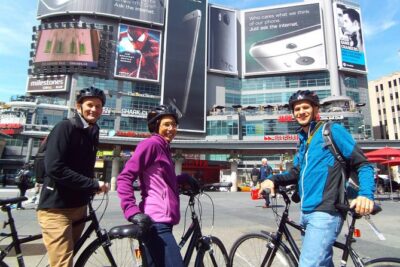 ★ 5.0Downtown Toronto Bike TourFrom $93336 reviews
 ★ 5.0Toronto Distillery District Walking TourFrom $21327 reviews
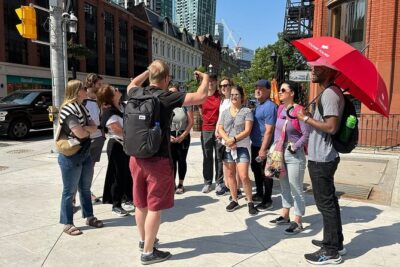 ★ 4.5Old Town Toronto Highlights 3 Hour Walking Tour | Gratuity-BasedFrom $5290 reviews
 ★ 4.8Toronto: Distillery District Historic Walking TourFrom $20267 reviews
 ★ 5.030-Minute Distillery District Segway TourFrom $36214 reviews
Browse the lists this tour appears in