
REVIEW · WALKING TOURS
Irish Famine in Montreal Walking Tour
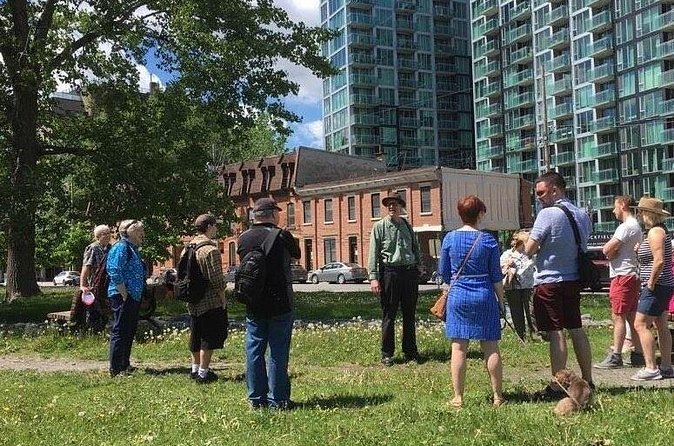
A city’s hardest stories can be walked. This Irish Famine in Montreal Walking Tour connects Irish Famine refugee history to real places you can stand on and look at. It’s a focused, English-language walk with a mobile ticket, and the sites along the way are free to visit.
I especially like the way the tour handles the locations with clear, on-the-ground stops, not vague pointers. You get a route that moves from the Old Port area to a specific spot by the Lachine Canal, then finishes at the monument that marks the graves of over 6,000 Irish Famine Refugees.
One thing to consider: the subject is heavy, and the time at each stop is short. If you want lots of detail, plan to ask questions and bring your own curiosity.
In This Review
- Key highlights you will feel right away
- Irish Famine in Montreal Walking Tour: why this walk hits differently
- Where to start and how to find the group fast
- Stop 1 at the Old Port of Montreal: arrivals, displacement, and context
- Stop 2 by the Lachine Canal: finding the mass grave location
- Stop 3 at the Black Rock Montreal Irish Monument: over 6,000 names remembered
- What you pay for: $20.23, free sites, and the guide’s job
- Weather, timing, and the pace you should expect
- Who this Montreal Irish Famine walk is best for
- A quick reality check: what to bring and how to prepare
- Should you book the Irish Famine in Montreal Walking Tour?
- FAQ
- How long is the Irish Famine in Montreal Walking Tour?
- Where does the tour start and end?
- What time does the tour begin?
- Is the tour offered in English?
- Is there a group size limit?
- What is the cancellation policy?
Key highlights you will feel right away
- Three stops, one theme: Old Port, Lachine Canal area, then the Black Rock Irish Monument.
- A guide points to the exact place: you’re shown where a mass grave is located near the Lachine Canal.
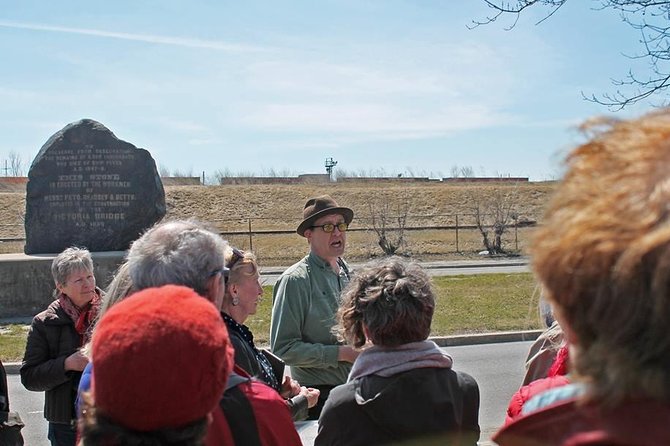
- A strong ending at Black Rock: the gravesite of over 6,000 Irish Famine Refugees.
- Free admission at every stop: you pay for the guide and interpretation, not entry fees.
- Small group feel: max 40 travelers, so it stays workable for questions.
- Two hours that fit a busy afternoon: starts at 2:00 pm and runs about 2 hours.
Montreal at walking pace, a few more routes
- The Original Old Montréal Walking Tour by Guidatour★ 4.5 · 2,217 reviews
- Old Montreal Small-Group Walking Tour | Max 10 | by MTL Detours★ 5.0 · 2,088 reviews
- Montréal: The Original Old Montréal Walking Tour★ 4.8 · 911 reviews
- Old Montreal: Traditional Ghost Walk of the Haunted City★ 4.7 · 746 reviews
Irish Famine in Montreal Walking Tour: why this walk hits differently
This is not the kind of tour where you mainly collect photos. It’s a guided walk where the point is to connect a tragic chapter of history to physical locations in Montreal. You’ll move through three key stops that turn the city into a map of survival, hardship, and burial practices during the Irish Famine era.
What I like most is the structure. You start with the Old Port area, where the story of arrivals and displacement makes sense in a real urban setting. Then you go to the Lachine Canal area, where you’re guided to a site tied to a mass burial. Finally, you end at the Montreal Irish Monument at Black Rock, the gravesite linked to over 6,000 Irish Famine Refugees. That last stop gives the experience a clear, emotional landing point.
The tour is also priced in a way that feels fair if you care about interpretation. At $20.23 per person, you’re mostly paying for the guide’s role in explaining what you’re seeing. Add that the stops are free to access, and the value starts to make sense fast.
Where to start and how to find the group fast
The meeting point is the Montreal Museum of Archaeology and History, 350 Pl. Royale, Montréal, QC H2Y 3Y5. The walk begins at 2:00 pm, and it ends at the Montreal Irish Monument on Rue Bridge, Montréal, QC H3K 1X8.
Because the tour is timed and only runs about two hours, I recommend you show up a few minutes early so you’re not scrambling for the start. If you’re using public transit, you’re in luck. The tour is noted as near public transportation, which is handy in Montreal, where you can often avoid parking stress.
Also, you’ll get a mobile ticket, and confirmation is received at booking time. That’s a practical plus. No paper hunt. No scrambling through emails while you’re trying to stay focused on the story.
Finally, group size matters here. With a maximum of 40 travelers, the walk should feel organized and manageable, even if the topic is serious.
Stop 1 at the Old Port of Montreal: arrivals, displacement, and context
The first stop is the Old Port of Montreal, with about 30 minutes there. This is the kind of opening stop that works well because it frames what comes next. When you hear about Irish Famine refugees, you need to picture people arriving, trying to survive, and getting caught in systems that were not built for mass suffering.
At the Old Port, you’re looking at how the area relates to refugees connected to the Irish Famine. The exact details are delivered through the guide, but the purpose is clear: you start with the city setting, then you slowly narrow to specific places tied to burial and memory.
Practical note: 30 minutes passes quickly when you’re listening closely. If you like to read signs, take a quick look before you fully lock in to the guide’s explanation. You’ll get more out of the walk if you understand what you’re physically seeing while the history is being explained.
Value-wise, this opening stop is important. Without it, the later stops can feel like sad markers with no connective tissue. With it, the rest of the walk feels like a continuation of the same human story.



Stop 2 by the Lachine Canal: finding the mass grave location
The second stop is the Lieu Historique National du Canal-de-Lachine, usually referred to through the Lachine Canal area. This is brief, about 5 minutes, but it’s one of the most consequential parts of the walk. Your guide will show you the exact location of a mass grave nearby.
Short stop or not, this is where the tour earns its name. You are not just hearing an abstract claim. You’re being guided to a specific spot. That single change from abstract to location-based makes the experience hit harder. The city becomes specific. The tragedy becomes anchored to a place you can point to and remember.
A drawback to consider here is the time constraint. Five minutes can feel fast if you like to linger. If you have questions, ask them here, because you might not get the same chance later.
Also, think about your expectations. This is not a long cemetery-style visit. It’s a pinpoint stop. You’ll likely get a quick explanation from the guide, then move on. If you want to do more reading afterwards, make a note of what you want to research so you can follow up on your own time.
Stop 3 at the Black Rock Montreal Irish Monument: over 6,000 names remembered
The final stop is the Montreal Irish Monument, located at Black Rock. It’s about 10 minutes on the site. This is the gravesite of over 6,000 Irish Famine Refugees, and it’s the emotional finish line for the tour.
This stop is where the story stops being “what happened long ago” and starts being about memory. You’re ending at a marker tied directly to burial, and that matters because it turns history into something you can stand near. The number, over 6,000, gives you scale, and scale helps you understand what mass suffering meant in real life.
I also appreciate the tour’s overall pacing here. Starting with context, then moving to a mass grave location, then closing at the monument gives a clear arc. By the time you reach Black Rock, you’re not just absorbing facts. You’re processing the theme.
The tour ends at Rue Bridge, and your guide can give you directions at the end. That is useful because you’re finishing at a final site, not circling back to where you started. You don’t want to guess your way out while you’re still thinking about what you just learned.
What you pay for: $20.23, free sites, and the guide’s job
The price is $20.23 per person, and the tour runs about two hours. On paper, it doesn’t look expensive, but the real question is what the money covers.
Each stop has admission that is free. That means your payment isn’t buying entry tickets. You’re paying for interpretation, the guided route, and the value of a person who can connect what you see to what it means.
That’s why the short, focused format can still feel worth it. The walk is designed to hit three specific points of interest without turning into a long slog. If you like tidy structure, this tour fits your style.
There’s also social proof here that you can take seriously. The tour has a rating of 5, with 23 reviews, and it is recommended by 100% of those reviews. While ratings are never the whole story, this kind of consistent feedback usually means the guide delivery and route make sense for most people.
Finally, the tour is booked about 27 days in advance on average. That usually signals that the experience has predictable schedules and that people plan ahead, which matters for a fixed 2:00 pm start time.
Weather, timing, and the pace you should expect
This experience requires good weather. If it’s canceled due to poor weather, you’ll be offered a different date or a full refund. The tour also requires a minimum number of travelers. If that minimum isn’t met, you’ll get a different date or full refund.
So, what should you do? Check the forecast close to 2:00 pm. Montreal weather can swing, and you don’t want to arrive and discover you’re waiting around for a decision.
In terms of physical demand, the tour asks for moderate physical fitness. You’re walking between three locations, and the time at each is relatively short. Still, you are outdoors, and short distances can add up, especially if you move with listening attention.
Finally, it’s a mobile ticket tour with service animals allowed, and it’s offered in English. If you prefer hearing the story in English and you don’t want an audio-only format, that’s a direct fit.
Who this Montreal Irish Famine walk is best for
This tour is a good match if you want a history walk that stays grounded in place. It works especially well for people who:
- like guided interpretation rather than self-guided reading
- want a two-hour activity that fits into an afternoon
- are interested in how Montreal connects to Irish Famine refugee stories
- are comfortable with heavy topics and want to learn from them directly
It’s also a solid choice for visitors who want fewer stops with more meaning. Three stops in about two hours is not a full-day marathon, so you can pair it with another Old Montreal activity afterward.
If you dislike somber history, you might find this tour emotionally intense. But if you can handle the theme, you’ll probably feel it most strongly because the route is short and the focus is tight.
A quick reality check: what to bring and how to prepare
Since the tour is weather dependent, dress like you expect to be outside for roughly two hours. Layering helps because Montreal can change temperature quickly.
Bring a charged phone if you’re using the mobile ticket. Even though the stops themselves have free admission, the tour’s ticket format is still a practical detail you’ll want ready.
Because each stop has a time window, I recommend you come with one or two questions in mind. For example, you can ask how the Old Port setting relates to refugee arrival stories, or what the guide emphasizes about the significance of the mass grave location.
Lastly, pay attention to the guide’s pointing. This tour includes a moment where you’re shown an exact location by the Lachine Canal. If you zone out for a minute, you can miss the whole point of that stop.
Should you book the Irish Famine in Montreal Walking Tour?
If you want a compact, guided walk that connects Irish Famine refugee history to specific Montreal locations, I think this is a smart booking. The combination of a clear route, free admission stops, and interpretation from a guide makes the value feel practical. And with a 5-star rating and strong recommendation rate, it’s doing something right.
I would only hesitate if you’re looking for a lighter, sightseeing-only experience. This is a memorial-focused walk with heavy themes, and the stop times are short, so your experience depends on your willingness to listen and ask questions.
If that sounds like your kind of travel, book it. Arrive early, dress for the weather, and give yourself permission to slow down at the end, Black Rock, where the story lands.
FAQ
How long is the Irish Famine in Montreal Walking Tour?
The tour lasts about 2 hours.
Where does the tour start and end?
It starts at the Montreal Museum of Archaeology and History, 350 Pl. Royale, Montréal, QC H2Y 3Y5. It ends at the Montreal Irish Monument on Rue Bridge, Montréal, QC H3K 1X8.
What time does the tour begin?
The start time is 2:00 pm.
Is the tour offered in English?
Yes, the tour is offered in English.
Is there a group size limit?
Yes, the tour has a maximum of 40 travelers.
What is the cancellation policy?
Free cancellation is available. You can cancel up to 24 hours in advance for a full refund, and the cutoff is based on the experience’s local time. If the tour is canceled due to poor weather, you’ll be offered a different date or a full refund.
Montreal on Foot


Just off the notebook: recent Montreal write-ups
- Secret Food Tours: Montreal – Jean-Talon & Little Italy
★ 4.0 · 4 reviews - Montreal to Quebec City Tour with Private Transportation
★ 5.0 · 4 reviews - Montreal: Iconic Landmarks All-Inclusive VIP Experience
★ 4.7 · 4 reviews - A Walking Tour of Old Montreal
★ 3.8 · 4 reviews - Day at Mont-Tremblant National Park
★ 4.0 · 5 reviews - Old Montreal: Self-Guided Tour from Place D‘Armes to Old Port
★ 5.0 · 5 reviews
Walking Tours, compared.
 ★ 5.0Quebec City Walking TourFrom $304,716 reviews
 ★ 4.8Old Quebec City: Grand Walking Tour with Private OptionFrom $292,609 reviews
 ★ 4.5The Original Old Montréal Walking Tour by GuidatourFrom $262,217 reviews
 ★ 5.0Old Montreal Small-Group Walking Tour | Max 10 | by MTL DetoursFrom $442,088 reviews
 ★ 5.0Gastown Historic Walking Food TourFrom $1161,863 reviews
 ★ 5.0Old Quebec Classique Walking Tour with FunicularFrom $421,317 reviews
 ★ 5.0Vancouver Lost Souls of Gastown Walking TourFrom $291,273 reviews
 ★ 4.6Quebec: Crimes of New France Animated Walking TourFrom $20926 reviews
Browse the lists this tour appears in