

REVIEW · HALIFAX, PEGGY'S COVE & THE SOUTH SHORE
Half-Day Historical Tour of Halifax
Halifax history comes with real waterfront drama. In a small-group van tour with guide Paul, you’ll get the story behind Halifax and Dartmouth’s landmarks, from Pier 21 to the Halifax Explosion and Maritime history. I love how the tour mixes big events with human details, so it feels personal, not just scenic sightseeing.
One more plus is the door-to-vehicle transfers from downtown hotels or the port area, which keeps your day from turning into a puzzle. The main drawback to consider is time pressure, especially if you’re on a cruise schedule, since the guide may shorten stops to get you back.
In This Review
- Key highlights worth planning for
- Why a small-group van tour works in Halifax
- Pier 21, the Halifax Farmers Market, and the people behind the city
- The downtown boardwalk, Georges Island forts, and the harbor’s hidden angles
- Alexander Keith to HMCS Sackville: beer, ships, and war memory
- Maritime Museum of the Atlantic, Historic Properties, and waterfront architecture
- The civic core: Old Burying Ground, Province House, and Government House
- Cemeteries and cathedrals: where Halifax keeps its stories
- Halifax Citadel at noon, and the Old Town Clock that fixed tardiness
- Point Pleasant Park, Dalhousie and King’s College, and the Mont Blanc anchor
- Lunch with a view in Dartmouth, plus Fisherman’s Cove to wrap the day
- Is it worth $131.43? Value, timing, and who should book
- Should you book this Halifax history tour?
- FAQ
- How long is the Half-Day Historical Tour of Halifax?
- What’s the group size?
- Do you pick up from downtown hotels or the cruise port?
- What’s included in the tour price?
- Is lunch included?
- What should I know about weather?
- Where does the tour start and end?
Key highlights worth planning for

- Max 10 people, so you actually hear the guide instead of wrestling for volume
- Paul’s storytelling and photo-friendly routes, including places other bus tours tend to skip
- A strong Titanic and Halifax Explosion focus, plus the graves and memorials that connect it all
- Downtown walking is limited, but you still want comfy shoes for a few short stretches
- Flexible viewpoint stops, from Georges Island harbor forts to Point Pleasant Park trails
- Lunch is optional, and the seafood stop is designed to move quickly
More of the harbour city and the coast road
- Halifax Harbour Hopper Tour★ 4.5 · 1,296 reviews
- Halifax Peggy’s Cove Express★ 4.0 · 801 reviews
- Halifax Small-Group Express Peggy’s Cove Tour★ 4.5 · 544 reviews
- Small Group Tour – Peggy’s Cove, Lunenburg, the Annapolis Valley★ 5.0 · 401 reviews
Why a small-group van tour works in Halifax
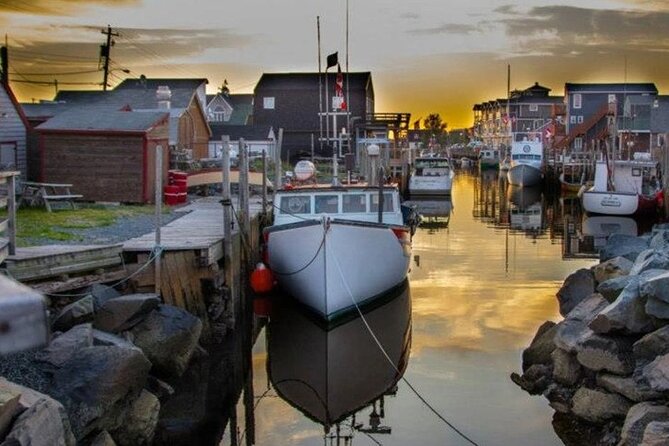
Halifax can look compact on a map, but the history is spread out. This tour uses a 15-passenger Ford Transit high-roof van to link the big sites without eating your day in long taxi rides. You get bottled water and WiFi on board, and the guide uses visuals while you’re in transit, which helps you keep context while you travel.
What I like most is the pacing. You’ll do short walks at key stops, but the day stays mostly in motion. That makes it practical if you want the highlights and context without turning it into an all-day marathon.
Another smart detail: seating is first confirmed, first choice. If you care about views out the windows, arrive a few minutes early and try to get your preferred side.
Pier 21, the Halifax Farmers Market, and the people behind the city
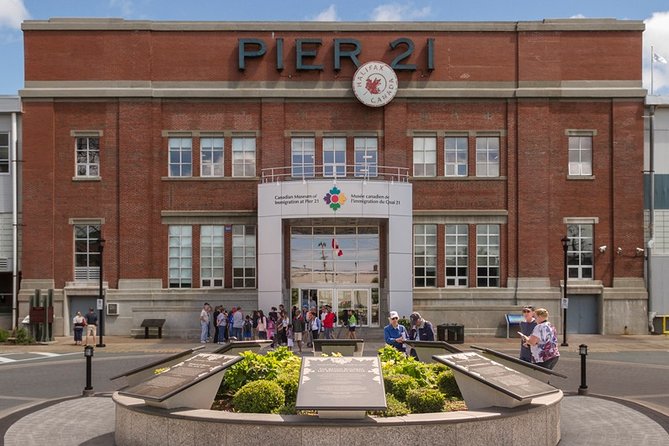
The tour opens at Pier 21, described as the Gateway to Canada, and it’s a perfect start. Before you even start hopping between neighborhoods, you get the big “why Halifax” framing: this harbor wasn’t just a backdrop, it was a doorway.
Then the story pivots to food and civic life at the Halifax Farmers Market. The market is traced to a Royal Proclamation in June 1750, just a year after Halifax’s founding. You’ll hear how the market started as a place for meat, livestock, and produce, and how the city later incorporated and protected public access to the market site. The market’s move to the Halifax Seaport in 2010 is also key, since it explains why this is both a historic institution and a modern visitor draw, with over 250 vendors today.
From there, the guide gets personal with names and memorials. You’ll see the Italian-born sculptor Armando Barbon’s work, with the story of separation, faith, and family reunification. And you’ll meet shipping history through Sir Samuel Cunard, a Halifax-born founder of the Cunard Line. Those people stories help the whole city feel less like a textbook.
The downtown boardwalk, Georges Island forts, and the harbor’s hidden angles
Halifax’s waterfront shapes everything, and the tour uses that advantage. You’ll hear about the downtown boardwalk and the scale of the natural harbor, which gives you the “hold on, this place matters” perspective fast.
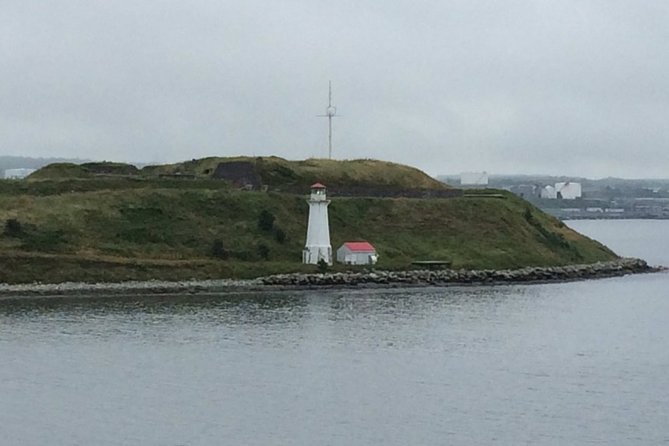
One of the most fascinating stops is Georges Island. The guide explains how its strategic location in the middle of Halifax Harbour made it central to British seaward defenses in the 18th and 19th centuries. Fort Charlotte and its seaward-facing batteries come up, plus the island’s underground tunnel complex and one of Canada’s early fully automated lighthouses.
The most emotional layer here is the island’s prison use during the deportation of the Acadians, known as Le Grand Dérangement. You’ll hear that between 1755 and 1763, Georges Island functioned as a holding area. And because the tunnels and subterranean passages are part of the story, local folklore hangs around the island like fog, even if you don’t see every passage yourself.
If you like history with physical scale and geography, this stop will land hard. You’re not just hearing dates, you’re getting why those dates happened here.
More routes into older Halifax

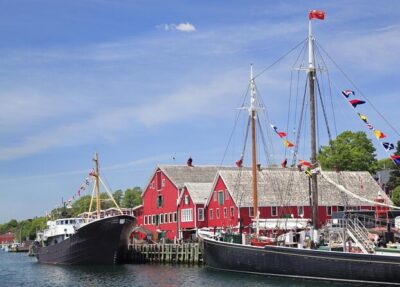
Alexander Keith to HMCS Sackville: beer, ships, and war memory

Halifax has a strong brewing tradition, and the tour includes a stop tied to Alexander Keith’s Nova Scotia Brewery. You’ll learn that it opened nearly 200 years ago and remains an active destination for beer lovers. The guide frames it as part business history and part cultural identity, tied to Keith’s Nova Scotia roots.
From beer you jump to naval heritage with HMCS Sackville. This is Canada’s naval memorial and the only one of 269 Allied corvettes from the Second World War that remains. It also connects to the larger Canadian shipbuilding effort, since 123 corvettes were built in Canada. If you’ve ever wondered how war history stays “still and visible” after the ships are gone, this is one of the clearest answers you’ll find.
Even if you don’t care about ships, the connection between Halifax, Atlantic travel, and global conflict shows up in your head in a new way after this segment.
Maritime Museum of the Atlantic, Historic Properties, and waterfront architecture

One stop you’ll be told to visit is the Maritime Museum of the Atlantic. The guide strongly recommends it before or after the Halifax history tour, because it covers World War convoys, Days of Sail, the Age of Steam, and Titanic and Halifax Explosion exhibits. Even if you don’t go during the tour, it’s the place to backfill details you’ll hear in passing while moving through the city.
Then you’ll shift toward the downtown waterfront layers at Historic Properties, a National Historic Site featuring three blocks of old waterfront warehouses and Victorian-Italianate façades from the late 1700s into the early 1800s. The value here is seeing restoration work in action, plus understanding that “heritage” is not just a word, it’s a set of buildings the city has kept alive.
You’ll also encounter the Round Church, Saint George’s, built in 1800 for the Little Dutch Church population. It’s described as a cylindrical wooden church with Palladian style influences tied to Edward, Duke of Kent. It’s a different kind of history stop, more architecture-driven, and that variety keeps the day from feeling one-note.
The civic core: Old Burying Ground, Province House, and Government House
Downtown Halifax does a nice job of putting government and memory in the same view. The tour includes key landmarks like Halifax City Hall, built 1887 to 1890 and designated a National Historic Site of Canada in 1997. It’s a good anchor stop for understanding how the city organized itself once it grew beyond a colonial outpost.
You’ll also visit Province House, Canada’s oldest legislative building and home to Canada’s first elected House of Assembly. The tour points out that it has two architectural styles, Regency and Victorian, which helps explain why it looks like it grew up in stages.
Then it’s Government House, described as the oldest official residence in Canada and the working residence of the Sovereign’s representative in Nova Scotia for more than 200 years. For many visitors, seeing art and antiques is the easy part. The real payoff is understanding why a place like this exists at all, and how that role shapes civic identity.
And you’ll meet memory in the form of the Old Burying Ground National Historic Site, with more than 1,200 head and foot stones. It’s set apart by stone walls and an iron fence, now serving as a green space in the middle of urban life. If you’re trying to understand Halifax’s character, this stop does it without speeches.
Cemeteries and cathedrals: where Halifax keeps its stories

If you want the Titanic and Halifax Explosion narratives to feel real, the cemeteries are where the tour turns from “sites” into “meaning.” The day includes Camp Hill Cemetery, which replaced the Old Burying Ground in 1844. Notable interments include Viola Desmond, Alexander Keith, and Joseph Howe, which is a reminder that Halifax history isn’t only about ships and disasters.
The tour also weaves in the human cost of disaster through Titanic-related graves. You’ll hear about Roman Catholic Titanic victims at Mount Olivet Cemetery, including Margaret Rice and details about “Ashpan Annie,” the miracle child of the Halifax Explosion. You’ll also hear the story of Vincent Coleman, described as a hero of the Halifax Explosion.
At Fairview Lawn Cemetery, the guide points out where 121 Titanic victims are interred and shares names such as J Dawson and Sidney Leslie Goodwin, plus notes about the Halifax Explosion unknown and additional Halifax victims interred there.
You’ll also see Holy Cross Cemetery and Our Lady of Sorrows Chapel, built quickly by community effort in 1843, plus older French stained-glass windows dating back to the 1500s. For places of worship, the tour includes Saint Mary’s Cathedral Basilica with Gothic Revival design, and it covers All Saints Cathedral too, including the detail about the first Titanic funeral for Mr William Henry Harrison.
One word of advice: this part of the day can feel heavy. Bring a calm mindset. The guide handles it with a steady, respectful tone.
Halifax Citadel at noon, and the Old Town Clock that fixed tardiness
The tour’s energy peaks around Halifax Citadel National Historic Site when the famous “Noon Gun” happens. You’ll be told that firing is part of the Halifax tradition since 1856, plus there’s the Changing of the Guards linked to the 78th Highlanders. The guide explains why the current Citadel, completed in 1856 and called Fort George, matters: it’s the fourth fort in a series on Citadel Hill, with a star shape built for defensive arcs of fire.
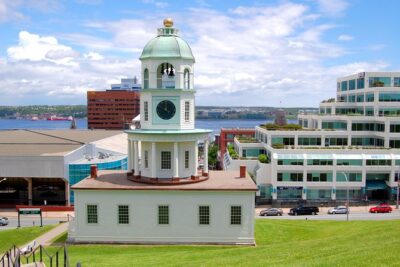
Then comes a smaller but fun detail at the Old Town Clock. The idea of a clock for the British Army and Royal Navy garrison is credited to Prince Edward, Duke of Kent. The story is that the clock idea was meant to address the garrison’s tardiness, and you’ll hear that Prince Edward arranged for a turret clock before returning to England in 1800. It’s the kind of story that turns military history into something human.
If you can time your arrival so you catch the noon moment, do it. Even if you’re not a “fort person,” it’s one of the few ways the city’s past becomes a scheduled event.
Point Pleasant Park, Dalhousie and King’s College, and the Mont Blanc anchor
Not everything is battle and tragedy. The tour includes Point Pleasant Park, a wooded 75-hectare space on the south end of the Halifax peninsula. You’ll hear there are lots of trails, including wide paths and many wheelchair-accessible routes. The guide points out preserved ruins of early fortifications and coastal ecosystems.
The tour also touches education and civic planning. Dalhousie University is described as founded in 1818 by George Ramsay, the 9th Earl of Dalhousie, with financing linked to customs duties collected during the War of 1812 occupation of Castine, Maine. King’s College is included too, founded in 1789, described as the oldest chartered university in Canada and the first English-speaking university in the Commonwealth outside the United Kingdom.
Then you hit a powerful physical reminder of the 1917 explosion with the Mont Blanc Anchor Site. The tour points out a 1,140-pound anchor shaft that flew 2.3 miles after the Halifax Explosion. You might not have the “size in your head” before you see it, and that’s why this stop matters.
Short stops like the Mont Blanc anchor are also good for stamina. They keep the day moving without requiring you to walk long distances.
Lunch with a view in Dartmouth, plus Fisherman’s Cove to wrap the day
If you choose the optional lunch, it’s at Evan’s Seafood with a view over Halifax. The guide explains that food orders are phoned ahead to speed things up, and there’s a gluten-free lunch option if you wish. Lunch is not included in the tour price, so think of it as a planned add-on, not a surprise bill.
Then the tour heads to Fisherman’s Cove. This is described as a restored 200-year-old working fishing village with colorful buildings and plenty of photo opportunities. It’s a nice emotional counterweight after the heavier stops, because you end the day somewhere that feels lived-in rather than memorialized.
If you’re the type who likes your vacation photos to tell a story, this ending will help.
Is it worth $131.43? Value, timing, and who should book
At $131.43 per person for about six hours, the value comes from three things: the small group size, the pickup transfers, and how much the guide packs into one day without turning it into a long van slog. You’re paying for context. With this many stops tied to events like Pier 21, the Halifax Explosion, and Titanic-era connections, the guided explanations are what make it worth it.
Where timing matters most is if you’re on a cruise. The tour can include ferries between Dartmouth and Halifax, and you’ll want buffer time. If your port call is tight, plan to treat this as a “best of” route rather than a guarantee that every stop will run exactly as listed.
This tour is a great match if you:
- Want Halifax and Dartmouth in one half-day with a guide who links places to events
- Care about Titanic and the Halifax Explosion beyond the headline
- Prefer a small-group format over big bus tours
- Would rather sit through the storytelling than play map-fu all day
If you hate walking at all, you might still be fine, since the stops are mostly short. Just remember you will step out at several points.
Should you book this Halifax history tour?
I think you should book it if you want a guide to help you understand what you’re seeing, fast. This is the kind of tour that makes Halifax feel like it has a pulse, not just a list of landmarks. If you’re a first-timer, or if you’ve been before and want the places you usually miss, it’s a smart use of time.
You should reconsider if your schedule is extremely rigid, like a cruise with minimal cushion, or if you’re not up for heavy subject matter. Otherwise, bring a curious mindset, wear comfy shoes for short walks, and plan your museum visit separately if you want deeper Titanic and maritime context.
FAQ
How long is the Half-Day Historical Tour of Halifax?
It runs for about 6 hours.
What’s the group size?
The tour is limited to a maximum of 10 travelers, with a minimum of four.
Do you pick up from downtown hotels or the cruise port?
Yes. You can get picked up from any listed downtown hotel. Cruise and driving visitors can meet at the Pier 22 Parking Lot at 1041 Marginal Road.
What’s included in the tour price?
Included items are an air-conditioned vehicle, bottled water, and WiFi on board.
Is lunch included?
No. Lunch is not included, though there is a stop for fresh Nova Scotia seafood lunch if you want it.
What should I know about weather?
This experience requires good weather. If it is canceled due to poor weather, you’ll be offered a different date or a full refund.
Where does the tour start and end?
It starts at 1041 Marginal Rd, Halifax, NS B3H 4P7, Canada, and it ends back at the same meeting point.
The Older Halifax





Harbour City and the Coast Road




Just off the notebook: recent Halifax write-ups
- Halifax’s Happy Hour Cruise Ft. a Live Musician
★ 5.0 · 5 reviews - Halifax: Sunset Wine and Cheese Sailboat Cruise
★ 5.0 · 5 reviews - Wine Enthusiast Tour Lead by a Sommelier
★ 4.5 · 6 reviews - Halifax: Party Cruise on the Harbour Queen
★ 4.7 · 6 reviews - Halifax City Sightseeing by Private a/c vehicle
★ 4.9 · 6 reviews - Private 5 Hour Tour to Peggys Cove and Historic Halifax
★ 5.0 · 7 reviews
Halifax, Peggy's Cove & the South Shore, compared.
 ★ 4.5Halifax Harbour Hopper TourFrom $631,296 reviews
 ★ 4.0Halifax Peggy’s Cove ExpressFrom $74801 reviews
 ★ 4.5Halifax Small-Group Express Peggy’s Cove TourFrom $50544 reviews
 ★ 5.0Small Group Tour – Peggy’s Cove, Lunenburg, the Annapolis ValleyFrom $180401 reviews
 ★ 4.5Peggy’s Cove & Halifax Historic Tour375 reviews
 ★ 4.5Halifax Premium Tour: Peggy’s Cove, Citadel & Titanic CemeteryFrom $96368 reviews
 ★ 4.5Halifax: Peggy’s Cove tourFrom $66275 reviews
 ★ 5.0Half Day Small Group Tour in Peggy’s Cove and Titanic CemeteryFrom $79242 reviews
Browse the lists this tour appears in