
REVIEW · HALIFAX, PEGGY'S COVE & THE SOUTH SHORE
Historic Halifax by Foot
Halifax rewards slow walking. This guided route strings together the city’s big historic stops, with smart commentary from guides like Victor and Chris, plus lots of chances to pause for photos. You get a tight loop of places you can actually orient yourself around for the rest of your trip.
I love two things right away. First, the small group size (max 20) usually makes it easier to hear and ask questions. Second, the stories connect landmarks to events, including Halifax Explosion context and military-era details, so the sites feel linked instead of random.
One thing to consider: this is not a lazy stroll. There is walking with some hills, and the pace can feel brisk, so if you want everything unhurried and flat, plan accordingly.
In This Review
- Key highlights to know before you go
- Getting your bearings in historic Halifax, on foot
- Price and value: what $36.80 buys you
- Start point at Pier 21, finish at the Ferry Terminal
- Stop 1, Halifax Public Gardens: Victorian calm and guided monuments
- Stop 2, Old Burying Ground: 1749 headstones and a Crimean War memorial
- Citadel Hill: commanding views, but you will not go inside
- St. Paul’s to Grand Parade: military square, church history, Halifax Explosion context
- Province House and the Old Town Clock: Palladian elegance and timekeeping by garrison
- Walking, hills, and pacing: plan for a real stroll, not a casual wander
- What’s included, what is not, and how to plan your day
- Who this tour is best for
- Should you book Historic Halifax by Foot?
- FAQ
- How long is the Historic Halifax by Foot tour?
- What does the tour cost?
- Is this a small group tour?
- Is the tour offered in English?
- Where does the tour start and end?
- Does the tour go inside Halifax Citadel National Historic Site?
- Are snacks or drinks included?
- What walking level do I need?
- What happens if the weather is poor?
Key highlights to know before you go

- Oldest Victorian Public Gardens in Canada: step into Halifax’s quieter side, with guided history and time to wander.
- Old Burying Ground (founded 1749): restored headstones and standout memorials, including the Crimean War memorial.
- Citadel Hill views without museum time: you get the height and photos, but not an inside visit to the Citadel.
- Grand Parade to St. Paul’s: military square, cenotaph context, and Halifax Explosion connections.
- Province House and Old Town Clock: Palladian architecture and a garrison-era landmark you pass near the finish zone.
More of the harbour city and the coast road
- Halifax Harbour Hopper Tour★ 4.5 · 1,296 reviews
- Halifax Peggy’s Cove Express★ 4.0 · 801 reviews
- Halifax Small-Group Express Peggy’s Cove Tour★ 4.5 · 544 reviews
- Small Group Tour – Peggy’s Cove, Lunenburg, the Annapolis Valley★ 5.0 · 401 reviews
Getting your bearings in historic Halifax, on foot

If you only have a short window in Halifax, this tour is built for getting oriented fast. You start near the Canadian Museum of Immigration and finish by the Halifax Ferry Terminal, which is a handy way to end your walk close to the waterfront action. The route also threads through key areas on foot so you start recognizing where things are when you go back out on your own.
What I like about this format is that it is not just “here is a building.” You move, you stop, you listen, you look, then you move again. That rhythm helps you remember what mattered and why it mattered. And with a max group size of 20, you are not stuck listening from the back of a crowd the whole time.
One more practical note: the tour is offered in English and uses a mobile ticket. If you like to travel light and keep your day simple, that is a plus.
Price and value: what $36.80 buys you
At $36.80 per person for about 2 hours 30 minutes, you are paying mainly for guided interpretation and time on the ground at multiple major sites. A big value lever here is that some of the stop areas are free to enter, like the Public Gardens and the Old Burying Ground. So you are not paying extra at every step just to see the places.
You also get photo stops built into the timing. That matters more than it sounds. Halifax has viewpoints and architecturally interesting streets, and if you show up without a plan you can waste time trying to figure out what to photograph and where the best angles are.
The other value lever is the guide. People mention guides such as Victor, Glenn, Chris, and Duncan, and they often highlight clear storytelling and good pacing for a walking route. You are not just sightseeing, you are collecting context you can use later when you explore on your own.
Start point at Pier 21, finish at the Ferry Terminal
The tour begins at the Canadian Museum of Immigration at Pier 21, 1055 Marginal Rd, Halifax. That is a smart starting location because it is close to where many visitors naturally begin their day. The end point is the Halifax Ferry Terminal, right on the waterfront.
This matters for two reasons. First, it helps you build an easy half day plan, especially if you are pairing the tour with an afternoon waterfront walk or nearby attractions. Second, it means you do not end in an awkward place far from food and transit.
Start time is 9:45 am. Going earlier in the day can help you beat crowds around the more popular photo moments, and it also gives you energy for the walk while your legs are still fresh.
More routes into older Halifax


Stop 1, Halifax Public Gardens: Victorian calm and guided monuments
Your first stop is Halifax Public Gardens, entered through the main gates. This is described as the oldest Victorian gardens in Canada, and the tour leans into that by having your guide explain the history and monuments inside.
Here is why this stop is worth it. Gardens can be one of those places where you either breeze through quickly or you miss what you are actually looking at. With a guide, you know what to notice and why certain monuments are placed where they are. Then you get time to explore on your own.
A practical tip: use the guided portion to learn the “map” of the space, then take your own time to wander for photos. The gardens are a great mental reset point early in the walk.
The entry ticket for this stop is free, and the tour notes about 30 minutes at the gardens. That is enough time to enjoy the setting without feeling rushed.
Stop 2, Old Burying Ground: 1749 headstones and a Crimean War memorial
Next up is the Old Burying Ground, Halifax’s oldest cemetery, founded in 1749. Your route passes restored headstones and includes some distinctive stories, including the only Crimean War memorial in North America.
This is one of those stops that can surprise you. Cemeteries are not everyone’s favorite travel sight, but this one is different because the tour frames it as a historical archive. The guide connects the dates and symbols to the people buried there, and that tends to make the place feel more real and less like a list of names.
Timing here is shorter, about 10 minutes, so do not expect deep wandering. Instead, pay attention while you are there, then take one or two photos if you want a record of where the stories took place.
Free admission is included for this stop area.
Citadel Hill: commanding views, but you will not go inside
Then you head toward Halifax Citadel National Historic Site for the top of Citadel Hill. You get a commanding view of downtown Halifax and the harbour, and your guide explains the importance of Halifax as a military establishment and why the Citadel matters.
Important detail for expectations: this tour does not go inside the Citadel. You are getting the viewpoint and the explanation, but not museum-style interior time.
If you love viewpoints, this stop is a highlight. If you were hoping for full Citadel interior exhibits, you may feel a bit shortchanged. On the flip side, you are trading that for more time elsewhere and a smoother pace for a walking route.
Photo note: Citadel Hill is the kind of place where you want your camera ready before you reach the main overlook. Guides sometimes move the group quickly between vantage points, so plan on capturing the moment as you arrive.
St. Paul’s to Grand Parade: military square, church history, Halifax Explosion context
After the Citadel viewpoint, your route connects two very recognizable landmarks: St. Paul’s Church and Grand Parade.
St. Paul’s is described as the oldest Anglican church in Canada and the oldest building in Halifax. The guide also explains its connection to the Halifax Explosion. That combination is what makes this stop click. You are not only seeing an old church, you are learning why it sits in the story of a major turning point.
Then you hit Grand Parade, a historic military parade square dating back to the founding of Halifax in 1749. Here, the tour uses the geometry of the square to explain where key civic and military landmarks sit around it. The north end includes Halifax City Hall. The south end includes St. Paul’s Church. In the middle is the cenotaph, originally built to commemorate soldiers from the First World War, Second World War, and the Korean War.
And yes, the guide ties in Halifax Explosion context here too, because the tour is clearly aiming for a “then and now” connection, not just a pile of facts.
This segment is also one of your best places to slow down mentally. You can look at the square and quickly understand how a parade ground, a church, and government offices would shape life in a growing colonial city.
Province House and the Old Town Clock: Palladian elegance and timekeeping by garrison
The next big architectural stop is Province House, constructed between 1817 and 1819. It is described as Canada’s longest serving legislative building and one of the finest examples of Palladian architecture in North America. Your guide also covers a famous 1835 court case tied to freedom of the press in Canada.
If you like when architecture connects to politics, this part of the tour pays off. It is not just about pretty buildings. It gives you a reason to remember the building shape and the political impact that came with it.
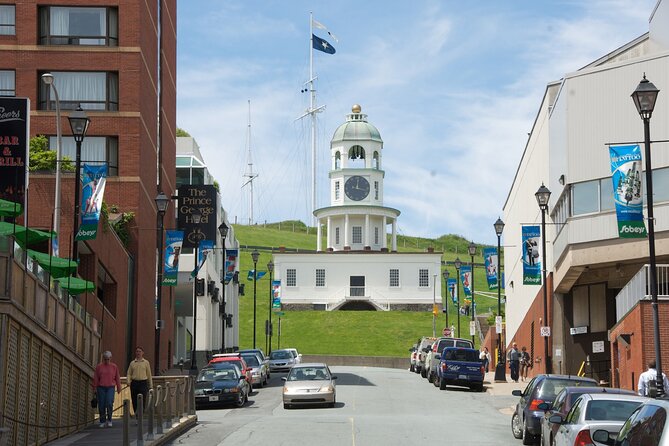
After Province House, your route takes you past the Old Town Clock. It was built in 1803 to help the local garrison keep time, and it has remained a Halifax landmark ever since. For many visitors, it is the first time they realize how practical timekeeping used to be in military settings, and how those structures outlast their original job.
This final stretch is a good wrap-up because you are shifting from military and memorial themes toward civic life and daily order. It helps the tour feel balanced instead of purely solemn.
Walking, hills, and pacing: plan for a real stroll, not a casual wander
This is a walking tour with a stated moderate physical fitness level. Persons with walking issues should not participate, and if you know you struggle with uphill stretches, treat that as a deal-breaker rather than a warning.
I also think you should mentally prepare for pace. Some guided walks feel leisurely, with frequent long stops. This one has stops that are measured in minutes, and the route includes an uphill push early on. That can be great if you like movement and photos on the way, but it can frustrate you if you want more breathing room or extra time to frame every shot.
A helpful strategy: keep your phone and camera accessible before you arrive at key spots. When the group starts moving, you want to capture quickly and then rejoin without falling behind.
Also, if you are sensitive to noise, you might find it useful to stand closer to your guide during busier parts. One practical note from guide dynamics: small groups still have moments where you have to manage hearing, especially outdoors.
What’s included, what is not, and how to plan your day
Included is straightforward: services of a local guide.
Not included: snacks, food, and beverages. Plan to eat before you start or after you finish. Since your tour ends near the ferry terminal, you can usually pivot quickly to a meal nearby rather than searching across town.
Because the tour is weather-dependent and requires good weather, I recommend you dress with layers and bring sun protection. Halifax can change quickly, and your best friend on a walking tour is clothing that lets you adjust without slowing down.
Who this tour is best for
This tour is ideal for:
- First-time visitors who want a hit list of historic Halifax without renting a car
- People who like stories tied to places, especially military and civic history
- Travelers who are comfortable walking for a couple of hours and do not mind some hills
It may not be ideal for:
- Anyone who cannot handle uneven sidewalks and uphill segments
- People who want a slow, stop-and-smell pace with lots of long time gaps at each site
- Visitors who only want one narrow angle of history, because the guide mixes military, memorials, architecture, and civic context
If you are traveling as a couple, solo, or with friends, the small group size and question time can make it feel closer to a private walk than a big tour bus experience.
Should you book Historic Halifax by Foot?
I would book it if you want a practical way to understand Halifax in a half-day window. The route hits the biggest historic anchors: Public Gardens, Old Burying Ground, Citadel Hill views, St. Paul’s, Grand Parade, Province House, and the Old Town Clock. For $36.80, you are buying a guided route that helps you make sense of the city fast, with a small-group feel.
I would hesitate if you have mobility limits, avoid hills, or prefer long dwell time at each site. Also, if you are hoping for an interior Citadel visit, this tour does not go inside, so you would need another plan for that.
Bottom line: if you can walk, enjoy guided storytelling, and like getting your bearings with a smart route, this is one of the better ways to spend a morning in Halifax.
FAQ
How long is the Historic Halifax by Foot tour?
The tour runs about 2 hours 30 minutes.
What does the tour cost?
The price is $36.80 per person.
Is this a small group tour?
Yes. The maximum group size is 20 travelers.
Is the tour offered in English?
Yes, it is offered in English.
Where does the tour start and end?
It starts at the Canadian Museum of Immigration at Pier 21, 1055 Marginal Rd, Halifax. It ends at the Halifax Ferry Terminal on the waterfront.
Does the tour go inside Halifax Citadel National Historic Site?
No. The tour provides walk to the top for views and guide explanations, but it does not go inside the Citadel.
Are snacks or drinks included?
No. Snacks, food, and beverages are not included.
What walking level do I need?
You should have a moderate physical fitness level. It is a walking tour, and it is not recommended if you have walking problems.
What happens if the weather is poor?
The experience requires good weather. If it is canceled due to poor weather, you will be offered a different date or a full refund.
The Older Halifax





Harbour City and the Coast Road




Just off the notebook: recent Halifax write-ups
- Halifax’s Happy Hour Cruise Ft. a Live Musician
★ 5.0 · 5 reviews - Halifax: Sunset Wine and Cheese Sailboat Cruise
★ 5.0 · 5 reviews - Wine Enthusiast Tour Lead by a Sommelier
★ 4.5 · 6 reviews - Halifax: Party Cruise on the Harbour Queen
★ 4.7 · 6 reviews - Halifax City Sightseeing by Private a/c vehicle
★ 4.9 · 6 reviews - Private 5 Hour Tour to Peggys Cove and Historic Halifax
★ 5.0 · 7 reviews
Halifax, Peggy's Cove & the South Shore, compared.
 ★ 4.5Halifax Harbour Hopper TourFrom $631,296 reviews
 ★ 4.0Halifax Peggy’s Cove ExpressFrom $74801 reviews
 ★ 4.5Halifax Small-Group Express Peggy’s Cove TourFrom $50544 reviews
 ★ 5.0Small Group Tour – Peggy’s Cove, Lunenburg, the Annapolis ValleyFrom $180401 reviews
 ★ 4.5Peggy’s Cove & Halifax Historic Tour375 reviews
 ★ 4.5Halifax Premium Tour: Peggy’s Cove, Citadel & Titanic CemeteryFrom $96368 reviews
 ★ 4.5Halifax: Peggy’s Cove tourFrom $66275 reviews
 ★ 5.0Half Day Small Group Tour in Peggy’s Cove and Titanic CemeteryFrom $79242 reviews
Browse the lists this tour appears in