
REVIEW · WALKING TOURS
The Sights of Banff: a Smartphone Audio Walking Tour
Banff has a lot to say, and this tour lets you listen while you walk. I like that the audio tour is offline-capable and uses live GPS to play the guide when you arrive, so you do not have to stare at your phone like a part-time job. You get a flexible way to explore Banff’s core, mixing big heritage sights with small street-level details along Bow River and Banff Avenue.
My favorite part is the value. For about $8.22 per person and roughly 1 to 1.5 hours, you can get a guided-feeling introduction without the cost and crowd hassle of a traditional group tour. The other big win is how easy it is to control your pace, including stop and start anywhere along the route and choose a start time that fits your day.
The main drawback to plan around is navigation and app behavior. A few people found it confusing at first or had trouble following later sections when the information did not match the walking flow, and one review mentioned app interface problems, so you will want a backup plan like using a map on your phone in parallel.
In This Review
- Key things I’d bet on before you go
- Price and time: the real value of a Banff audio walk
- How the smartphone app works (and why it’s not just a podcast)
- Walking route strategy: banish confusion before it starts
- Stop-by-stop: Banff’s buildings, gardens, river views, and street details
- Buffalo Nations Museum to Banff’s Administration Building
- Cascade Gardens and the pedestrian bridge with Mr. Banff
- Street corners that teach you what you are actually looking at
- Luxton Home Museum to Brewster-era Banff Avenue stops
- Churches, monuments, and the bridge between tourism and town memory
- Central Park, Banff Park Museum, and two more Avenue heritage stops
- Church naming, the Superintendent’s Residence, and closing at the Legion
- Who this tour suits best, and who should skip it
- Should you book the Sights of Banff smartphone audio tour?
- FAQ
- Do I need internet to use the tour?
- How long does the walk take?
- Are tickets included for the museums and homes?
- Will I need headphones?
- Can I pause the tour and keep going later?
- Is this tour private?
Key things I’d bet on before you go

- Offline listening: Download on Wi-Fi first so you can keep moving without worrying about cell service.
- Auto-play audio with live GPS: Commentary starts when you’re near the next stop.
- Trivia as you walk: A location-based guessing game adds a fun break from pure sightseeing.
- Flexible timing: You can pause, resume, and stop anywhere along the route.
- A mix of free and ticketed stops: Many locations are free, but a few key museums and historic homes may require admission.
Banff at walking pace, a few more routes
- The Banff Stargazing Tour – 2hr Walking Tour★ 5.0 · 189 reviews
- Banff: 4-Hour E-Bike and Walking Tour in Johnston Canyon★ 4.7 · 67 reviews
- Banff: Paranormal History Walking Ghost Tour★ 4.7 · 46 reviews
- Yamnuska Wolfdog Sanctuary Walk Ticket in Canada★ 5.0 · 37 reviews
Price and time: the real value of a Banff audio walk

At $8.22 per person, this is one of the cheaper ways to get structured Banff storytelling on your own schedule. You are not paying for a bus, a driver, or a large group headcount, so the money mainly goes toward the app experience and the audio content. The duration is also friendly, about 1 hour to 1.5 hours, depending on how often you pause, read, and take photos.
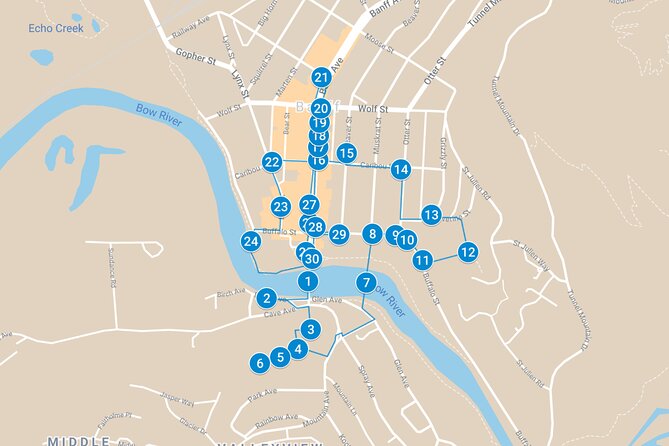
The route is roughly a 5 km round trip sightseeing loop. That matters because Banff Avenue can look walkable on a map, but it is still real walking once you add museum entrances, gardens, and river views. If you are short on time, you can treat this like an “orientation tour” first, then go back later for the attractions with longer stays.
One more practical point: the audio tour is described as a private tour/activity, meaning only your group participates. With smartphone tours, that usually translates to less waiting and fewer coordination issues, since you are not waiting for someone else to catch up.
How the smartphone app works (and why it’s not just a podcast)
The tour is delivered through a smartphone app, and that is the whole system. You download the tour before you go, and the tour is designed to work even without signal because offline use is supported. Once you start, the live GPS map shows where you are and where to go next.
When you get close to a stop, the guide commentary automatically plays. This is the big difference from a normal audio guide where you keep tapping play all the time. It also helps you keep your attention on the street and the buildings, not on your screen.
There are two other features worth noting. First, there is a location-based trivia game, where the audio plays, then you tap your answer right on your device. Second, headphones are optional. If you forget them, the audio can play from your device speaker, though in busy areas or wind, you might not hear it as clearly.
Now, here is the thing to prepare for. Some users reported the app interface jumping to other pages or making navigation harder. That does not mean the experience is doomed, but I recommend treating the first few stops as a warm-up period. Have your phone brightness reasonable, volume up, and plan to glance at your map so you feel confident about the next turn.
Walking route strategy: banish confusion before it starts
This is meant to be easy, with a start at 12 Banff Ave and the tour ending back at the same meeting point. Still, Banff Avenue has plenty of cross streets and side corners, and cold weather can make any extra searching feel brutal.
Here is how to set yourself up:
- Download the tour on Wi-Fi before you leave.
- Keep GPS on and let the app settle for a minute at your starting point.
- If you are prone to getting turned around, open your regular map app too, so you can compare street names and directions quickly.
- Consider bringing a power bank if you are out for longer than expected, since GPS use drains battery.
If it is winter, plan for comfort. One review mentioned trying to drive instead of walk during -19 temperatures, because the cold shortened how much they could enjoy on foot. In Banff winter, a short loop is still great, but dress like you expect to be outside longer than you think.
Stop-by-stop: Banff’s buildings, gardens, river views, and street details
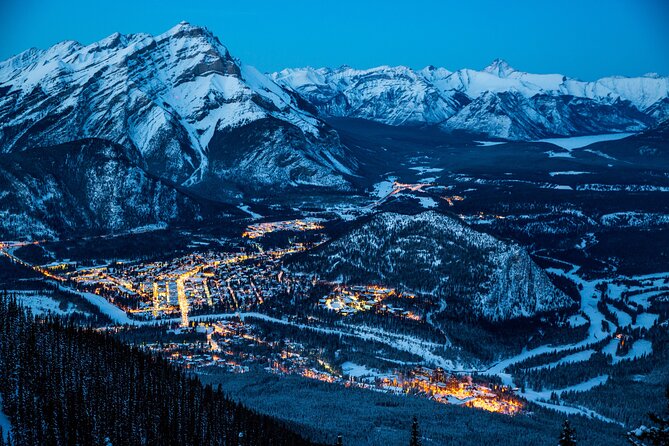
Below is the kind of story you will walk through. I’ll call out what to look for, what makes each moment worth your attention, and one potential downside to keep in mind.
Buffalo Nations Museum to Banff’s Administration Building
You start at the Buffalo Nations Museum, where the audio tour frames Banff’s past and present with a 5 km style loop. The guide points out major features like the Banff Administration Building, Luxton Home Museum, Central Park, and the Cascades of Time Gardens as parts of your story. A short trivia moment is baked in too, so this first section feels like it starts the narrative instead of just dropping you at random landmarks.
A note on effort: the tour’s first stop includes an admission ticket that is not included. That does not mean you cannot enjoy the audio around it, but if you want full value, double-check whether you plan to go inside.
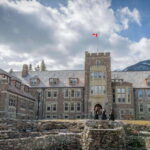
From there, you move to the Banff National Park Administration Building. This is a strong “look up and stare” stop, because the commentary is about why this building matters and what you are seeing as you stand there. Since it is explicitly listed as free access for this stop, it is a good place to pause for photos and then keep the walk moving.
Cascade Gardens and the pedestrian bridge with Mr. Banff
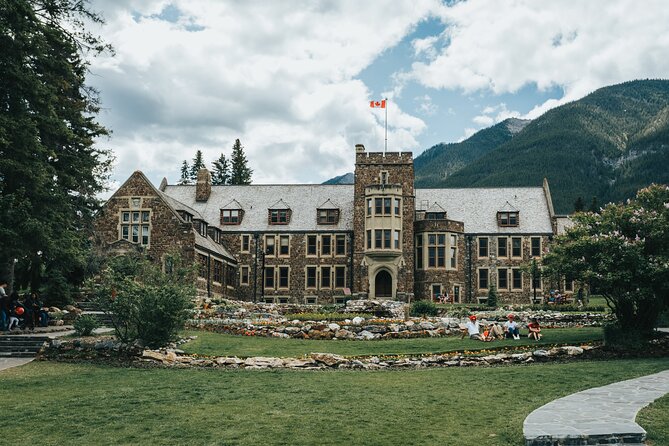
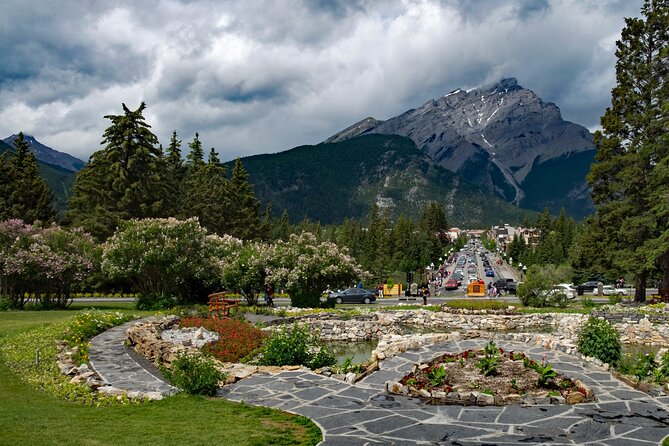
Next up is Cascade Gardens, a 4-acre park built in the 1930s with gardens terraced into a hillside. The audio calls out two points of interest: the Cambrian Pavilion and the Devonian Pavilion. This is one of the better “slow down” segments because gardens give you visual payoff even if you are not rushing.
Then the route crosses to the Banff Pedestrian Bridge, with an audio explanation tied to the story of Mr. Banff. The Bow River view is the big reward here. If you want a calm moment, time your pause for a quieter window, because standing on a river bridge naturally invites people to stop, too.
Street corners that teach you what you are actually looking at
After the bridge, the tour shifts to street-level details, and that is where this audio walk feels smarter than a list of famous sights.
- At Buffalo Street & Muskrat Street, you look for an elevation marker that looks like a coin. The audio helps you understand what it means, and suddenly sidewalk trivia turns into real place-awareness.
- At 514 Buffalo St, the audio points out the Crandell Peck Cabin, built in 1907 by Edward Henry Crandell using mostly locally sourced materials. This is a compact lesson in how Banff developed with the materials around it.
- At Buffalo Street & Otter Street, the tour asks about an inukshuk and points one out. Even if you have seen one before, the context makes it feel less like a random sculpture and more like part of the area’s cultural landscape.
Then you continue with more “look for this, then listen” stops:
- 525 Buffalo St (Banff Powerstation story): you learn how the power station helped streetlights and homes as early as 1905.
- Ken Madsen Path: the audio connects what you see on the path to Banff’s history.
- 117 Grizzly St (Tarry-a-while residence): the commentary ties the location to Mary Schaffer Warren and her early Rockies writing and painting.
- Otter Street & Caribou Street: you get a climate lesson as you walk, a helpful way to interpret what you see around you instead of treating Banff as just scenery.
The downside here is pacing. Some audio segments can feel long for quick stops, especially if you pause for shopping or photos at the same time. If you want to finish in closer to 1 hour, keep your breaks efficient.
Luxton Home Museum to Brewster-era Banff Avenue stops
The next highlight is the Luxton Home Museum, where the audio focuses on a pioneer family and what life looked like across nine decades. This stop has an admission ticket listed as not included, so decide ahead of time if you want to walk by for context or go in for the full museum experience.
Then the tour returns to Banff Avenue style landmarks:
- Caribou Street & Banff Avenue (Caribou Corner): the audio covers the Brewster family arriving in 1886 and setting up shop there.
- 204 Banff Ave (four sentries sculpture): short and clear, with a focus on why it has become a Banff mainstay.
From there you pass and listen at:
- Box 3100: a mural on Banff Avenue depicting the Cave & Basin site, giving you a quick entry point into a major Banff story.
- Banff Visitor Information Centre: the guide points out the building so you know where to find more ideas for the rest of your trip.
Churches, monuments, and the bridge between tourism and town memory
Next, you reach St. Paul’s Presbyterian Church, built in 1930, with the story going back to 1887 when St. Paul’s Church was established. This is a great “architecture plus timeline” stop, especially if you like learning how Banff’s institutions grew alongside tourism.
Then comes a warm-up theme with the fireplace stone monument at Banff Avenue & Elk Street. The audio does not focus on the weather, it focuses on the monument and what the place is meant to represent, which is a nice reminder that even simple structures have purpose.
You also see:
- Caribou Street & Bear Street: the audio points out the old Cascade lodge, connected to the Banff Freemasons.
- Whyte Museum of the Canadian Rockies: the guide talks about the museum’s goal of preserving and making Rocky Mountain history and culture accessible. Admission is not included, so this can be a “listen outside and decide” moment.
Central Park, Banff Park Museum, and two more Avenue heritage stops
At Central Park, you take a stroll and the commentary calls out a big pile of rocks in the middle. It sounds silly, but those kinds of details are often the ones that help you remember a place, because they stop the tour from being only about buildings and start making it about how public space tells a story.
Then there is Banff Park Museum, tied to a National Historic Site of Canada established in 1895. The audio mentions that it housed taxidermy specimens of animals, plants, and minerals associated with the park. Like a few other museum stops, admission is not included, but the point is that the audio sets the stage so you know what you are looking at if you choose to enter.
Finally, you finish the Avenue heritage stretch:
- Banff Avenue & Buffalo Street (Dave Whyte block): the commentary highlights significant heritage value as one of the oldest remaining, largely intact commercial buildings.
- 107 Banff Ave (Harmony Lane): you learn about a prominent commercial building built in a rustic national park style, with river stone pillars.
Church naming, the Superintendent’s Residence, and closing at the Legion
At Rundle United (Ralph Connor Memorial United Church), the audio gets personal. It explains the man behind the church’s name, and the tour includes a playful moment where the tour guide Don does his best Mr. Rundle impersonation, adding humor without derailing the facts.
At Beaver Street & Buffalo Street, the tour points out the Superintendent’s Residence and explains the responsibilities of the park superintendent who lived there. It’s a reminder that Banff National Park management is not just “visitors and hikes,” there was a whole administration behind the scenes.
You wrap up by seeing the Royal Canadian Legion Col. Moore Branch 26 and the cenotaph in front, built in 1920. The last section tends to land well because it brings the story to modern town memory, not just historical buildings.
Who this tour suits best, and who should skip it
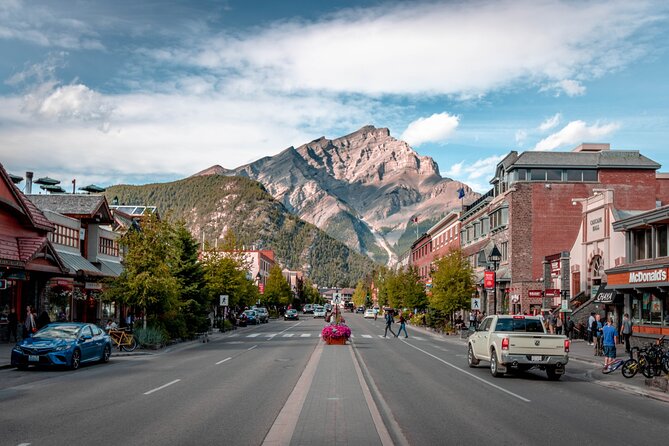
This is a great fit if you want an organized walk that costs little and lets you control your pace. You will like it if you enjoy:
- reading street-level details like elevation markers and building features
- learning how Banff grew around park administration and tourism
- getting an audio guide that triggers as you walk
It is less ideal if you hate app navigation or you need very clear, turn-by-turn street directions. Some people found later parts outdated or hard to follow, and one review asked for directions like a step-by-step path. If you are the type who gets frustrated when GPS is slightly off, bring a map app and use it early.
Should you book the Sights of Banff smartphone audio tour?
Book it if you want a low-cost way to learn Banff while staying flexible. The offline-capable audio, live GPS, and auto-play commentary make it feel like guided sightseeing without group pressure, and the mix of parks, churches, and Avenue heritage stops gives you more than just a photo walk.
Skip it or plan carefully if you expect flawless app performance, or if you are visiting in extreme cold and can only handle a short walk. In that case, you might still enjoy parts like the Cascade Gardens and bridge views, but have a shorter “time budget” so you do not end up rushing.
If you go in with the right mindset, this is a smart way to turn Banff Avenue into a story you can actually remember.
FAQ
Do I need internet to use the tour?
No. You should download the tour on Wi-Fi before you start, and the app can be used offline during the walk.
How long does the walk take?
Plan for about 1 hour to 1 hour 30 minutes, depending on how much time you spend at each stop.
Are tickets included for the museums and homes?
Some attractions list admission tickets as not included, including the Buffalo Nations Museum, Luxton Home Museum, Whyte Museum of the Canadian Rockies, and Banff Park Museum. Other stops are listed as free.
Will I need headphones?
Headphones are optional. Audio can play from your device speaker as well.
Can I pause the tour and keep going later?
Yes. The tour is described as stop and start anywhere along the route, with flexible start time and the ability to enjoy it anytime, not just on your booking date.
Is this tour private?
Yes. It is a private tour/activity, and only your group participates.
Banff on Foot
Just off the notebook: recent Banff write-ups
- Elevated Private Experience: Adventure & Wellness in Banff
★ 5.0 · 4 reviews - From Banff: Affordable Moraine Lake and Lake Louise Shuttle Bus
★ 5.0 · 4 reviews - Banff to Calgary or YYC Airport | Private Transfer
★ 5.0 · 4 reviews - Banff Gondola & Lake Minnewanka Cruise Combo
★ 5.0 · 4 reviews - Moraine Lake Lake Louise Johnston Canyon Emerald Lake Day tour
★ 5.0 · 4 reviews - From Banff: Winter Wonderland; Lake Louise & Johnston Canyon
★ 5.0 · 4 reviews
Walking Tours, compared.
 ★ 5.0Quebec City Walking TourFrom $304,716 reviews
 ★ 4.8Old Quebec City: Grand Walking Tour with Private OptionFrom $292,609 reviews
 ★ 4.5The Original Old Montréal Walking Tour by GuidatourFrom $262,217 reviews
 ★ 5.0Old Montreal Small-Group Walking Tour | Max 10 | by MTL DetoursFrom $442,088 reviews
 ★ 5.0Gastown Historic Walking Food TourFrom $1161,863 reviews
 ★ 5.0Old Quebec Classique Walking Tour with FunicularFrom $421,317 reviews
 ★ 5.0Vancouver Lost Souls of Gastown Walking TourFrom $291,273 reviews
 ★ 4.6Quebec: Crimes of New France Animated Walking TourFrom $20926 reviews
Browse the lists this tour appears in