
REVIEW · HISTORICAL TOURS
Sports, Street Skateboarding, Economics, History & Culture
Downtown Toronto can feel like one big “see it, snap it, move on” blur. This tour slows it down and turns the city into a story about street skateboarding and sports culture, with economics and film locations sprinkled in. I really like Duncan’s local, street-level perspective and the way the route uses real landmarks, like Nathan Phillips Square and the Toronto Path, to make history feel current. One catch: it’s a walking tour, so if you are sensitive to weather or long downtown blocks, plan for solid shoes and the conditions that day.
You cover a surprising range in about 1.5 hours: city squares and ice-rink views, the Bay Street film corridor, the Toronto Path network, the Financial District’s economic role, skateboarding along downtown architecture, then Brookfield Place and the arena area. It is also built for value, with a low price point and free-admission stops noted along the way, plus a Google Map of Duncan’s food and dessert recommendations.
If you like cities that feel lived-in, this is the kind of tour that helps you see what’s under the surface. You’ll finish with a better sense of how Toronto’s culture, money, media, and sports all share the same downtown blocks.
In This Review
- Key highlights you will care about
- A 90-minute Toronto mix of sports, screens, and skates
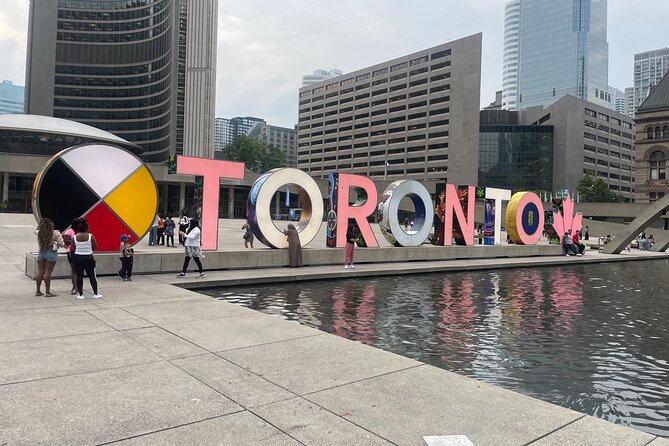
- Nathan Phillips Square and the Toronto Sign at the ice rink
- Bay Street Corridor: the Suits lobby spot and the real filming challenges
- The Toronto Path: wayfinding, pandemic disruption, and how businesses adapted
- Financial District history and why it matters for jobs
- Street skateboarding in downtown Toronto, past and present
- Brookfield Place: architecture plus the NHL Situation Room
- Legends Row outside Scotiabank Arena: Maple Leafs legacy to Kawhi Leonard
- Price, pace, and what you actually get for $11.22
- Who this tour suits best (and who might want another option)
- Should you book this Toronto downtown tour?
- FAQ
- How long is the tour?
- How much does it cost?
- Where does the tour start and end?
- Is the tour offered in English?
- Is there a maximum group size?
- Are tickets or admissions included?
- Is the tour dependent on weather?
- Does the price include tipping?
- Can I cancel and get a refund?
Key highlights you will care about
- Duncan leads with a local skateboarder’s take on downtown culture and architecture
- Street skateboarding history gets tied to specific urban structures and the current scene
- Suits filming lore and the Meghan Markle press-and-fans reality check add a pop-culture lens
- Toronto Path wayfinding shows how people actually move through the city
- Sports landmarks connect from Brookfield Place to Legends Row outside Scotiabank Arena
- Food and dessert map is included, so you get practical value after the walk
More routes into older Toronto
- Toronto: Dark History Nighttime Walking Tour★ 4.7 · 273 reviews
- Toronto: Distillery District Historic Walking Tour★ 4.8 · 267 reviews
- Toronto Local Beer Tour: 2 Beers at 2 Unique & Historical Pubs★ 5.0 · 154 reviews
- Old Town Toronto History Walking Tour★ 4.5 · 122 reviews
A 90-minute Toronto mix of sports, screens, and skates
This tour is short enough to fit into a busy schedule, but it does not feel like a rushed highlight reel. The whole point is how downtown Toronto overlaps in unexpected ways: money and media sit beside public squares, and street skateboarding grows out of the same hard edges and clean geometry you see in office towers and arenas.
You are walking through a version of Toronto that is less about postcard angles and more about how the city works. That includes why certain places became film locations, how the Path adapted after pandemic-era closures, and why skateboarding found downtown architecture in the first place. Even if you are not into skateboarding, you will still connect with the street-level creativity behind it.
And yes, you do get a bit of humor along the way, which helps when you are standing in the middle of a busy corridor and trying to picture what it was doing years ago.
Nathan Phillips Square and the Toronto Sign at the ice rink
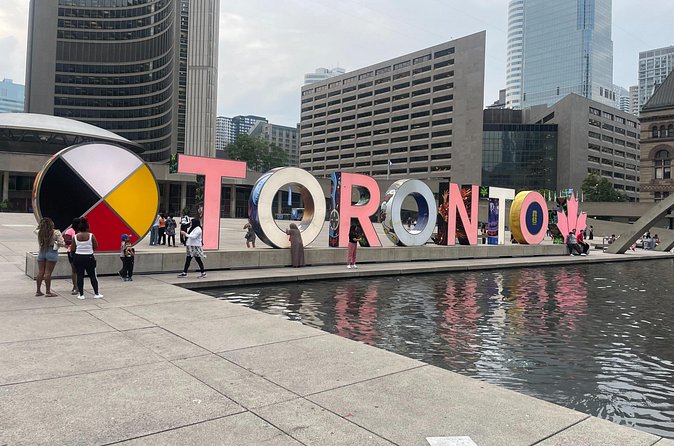
The tour’s downtown anchor is Nathan Phillips Square. You will learn how it shaped big moments in Canadian public life and how it looks today, including the famous Toronto Sign located by the ice rink.
What I like here is the contrast. It is a big, recognizable place, but the tour gives you the background so it stops being just a photo stop. If you catch the right moment, you also get a sense of how the square functions as a civic stage, not just a landmark.
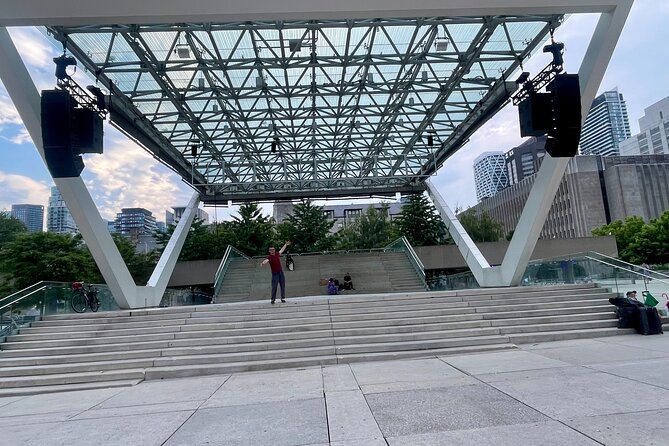
One extra detail you should look for during your visit is the nearby public-art and renewal energy around the square area, including a Reconciliation Garden that the tour spotlights. That matters because it shows Toronto changing its public spaces while still keeping them central.
Bay Street Corridor: the Suits lobby spot and the real filming challenges
Then you move into the Bay Street corridor, where the city’s polished look meets TV production reality. You will hear about the Suits lobby location, and the specific role Meghan Markle played as a paralegal on the show. The tour also talks about what filming brings with it: encounters with press and fans, plus the safety considerations that come with shooting in a public-facing downtown environment.
I like this part because it reframes what you are seeing. You are not just learning what show used which building, you are learning what it takes to film in a working business district. That includes the kinds of friction Toronto’s film industry can face when downtown is crowded, expensive, and constantly in motion.
If you enjoy screen-location trivia, this stop will feel like insider knowledge you can use while you watch episodes later. If you do not care about TV, it still works, because it explains downtown Toronto as a production machine, not a static backdrop.

The Toronto Path: wayfinding, pandemic disruption, and how businesses adapted
Next comes one of Toronto’s defining quirks: the Path, the connected underground pedestrian network. You walk through a section of it and learn the history of how it grew, then what happened when it closed during the pandemic.
The practical story here is the post-pandemic hybrid world, where office schedules changed and foot traffic did not return in a simple, full-time way. You will also learn how businesses adjusted, which helps you understand why certain spaces feel busy at certain hours and quieter at others.
You will even get into the tech side, including the Path’s wayfinding technology that helps people navigate the network. This is useful because Toronto’s underground can feel like a maze if you are relying on instinct. When you know what the wayfinding is designed to do, the Path becomes less stressful and more functional.
Financial District history and why it matters for jobs
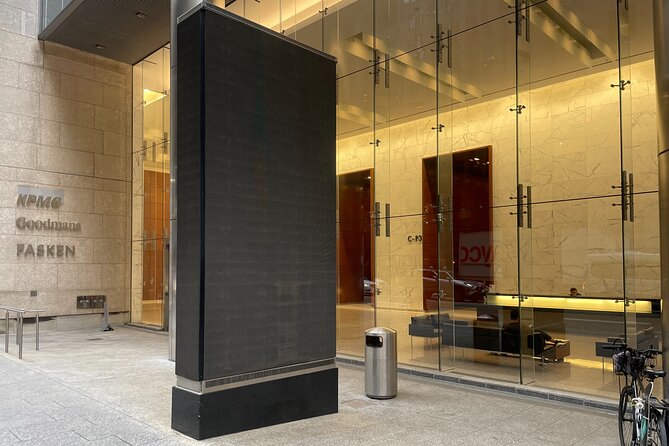
From the Path, the tour heads toward the Financial District. You learn about how it developed over time and why it matters to the Canadian economy, including the sheer scale of employment in the area.
This is not an abstract lecture. The value is that you are connecting economic power to street-level form. Tall buildings and polished streets are not just scenery, they represent where jobs cluster, where decisions get made, and where the city’s rhythms get set.
If you like understanding cities as systems, you will appreciate this stop. It gives context for why downtown Toronto has such a strong pull, not only for tourists, but for people working, commuting, and investing.
Street skateboarding in downtown Toronto, past and present
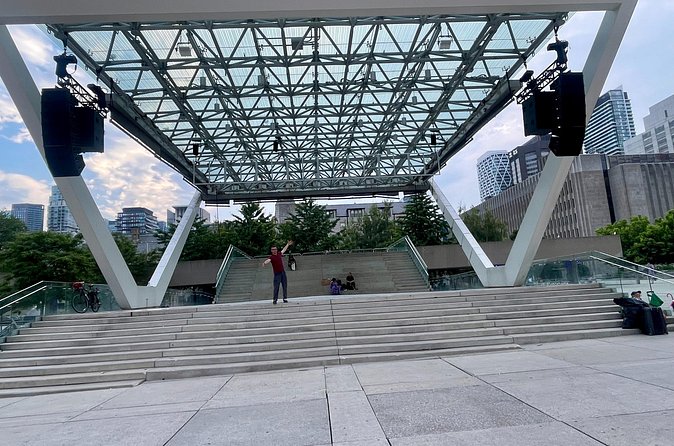
This is where the tour’s theme really locks in. You learn about the history and evolution of street skateboarding in downtown Toronto, including how professional skateboarders built early careers by filming tricks on urban architecture.
What I find smart here is the framing. Skateboarding is often treated like just a sport or just a style, but downtown architecture matters because it offers features designed for movement, angles, rails, ledges, and concrete textures. You begin to see downtown like a skate-friendly grid, even if you have never skated yourself.
Then the tour brings you to the present climate for street skateboarding in downtown Toronto. Even without getting overly technical, it helps you understand why the scene changes as cities tighten rules, repair surfaces, redevelop spaces, and shift public space priorities.
If you are curious about street culture, this portion is one of the most unique things you can do in Toronto without needing tickets or a museum line.
Brookfield Place: architecture plus the NHL Situation Room
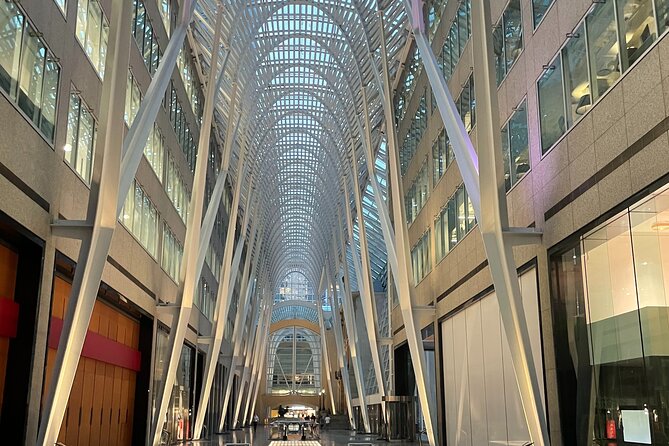
You continue to Brookfield Place, where the tour combines architecture with sports operations trivia. You will learn about the site’s history and what the buildings represent, then you’ll connect it to the NHL Situation Room, which is located in the southwest tower.
This stop is valuable because it explains a behind-the-scenes side of hockey. You are not just seeing an office complex and walking past it, you are learning why it matters to how the NHL runs, at least in terms of information and game-day support.
Brookfield Place also gives you a nice visual contrast to the more open civic spaces earlier in the tour. Here you get the city’s corporate muscle, and you feel it in the scale and design.
Legends Row outside Scotiabank Arena: Maple Leafs legacy to Kawhi Leonard
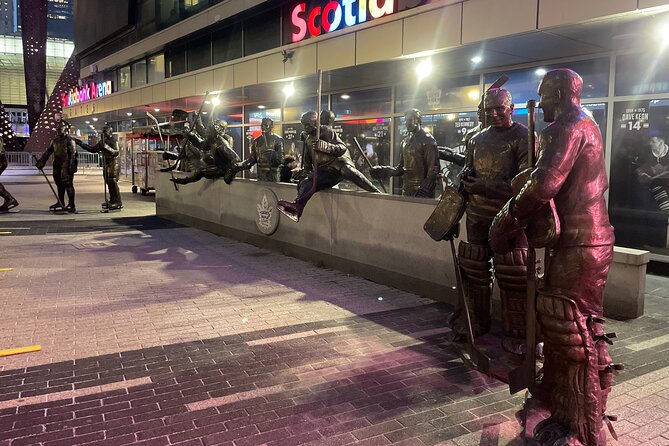
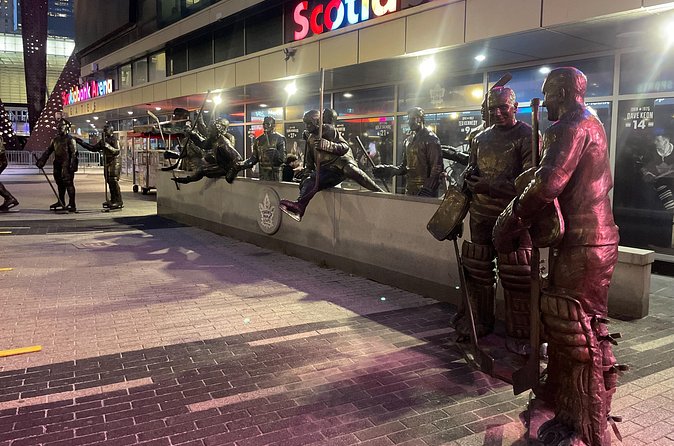
The walking portion ends at Legends Row, located on Raptors Way outside Scotiabank Arena. You will learn about the sculpture, Legends Row, including who created it, and you’ll hear about its focus on former Toronto Maple Leafs players.
Then the sports timeline shifts to the Toronto Raptors. You’ll hear about the team’s acquisition of NBA superstar Kawhi Leonard, their 2019 NBA Finals win, and the renaming of Bremner Street to Raptors Way. You also get a realistic angle on the team’s challenge of attracting and signing top NBA talent as the only Canadian team in the NBA.
This ending works because it ties emotion to place. Scotiabank Arena and the surrounding streets can feel like just another sports zone, but the tour makes it feel like a curated public story, with art, names, and street identity all reinforcing the franchise legacy.
Price, pace, and what you actually get for $11.22
At $11.22 per person for about 1 hour 30 minutes, the value is strong, especially for a downtown walk that connects multiple big themes without extra ticket costs at key stops. You also get a mobile ticket, and the tour is offered in English.
The real value, though, is not only the route. It is the added practical piece: you receive a Google Map of Duncan’s Toronto recommendations for food, drink, and dessert, plus travel advising at the end. That means you are leaving with a plan, not just memories.
Pace-wise, it is tight. The itinerary covers several distinct downtown areas, so expect a steady walk and a lot of “look up, listen, then move” moments.
One more thing to consider: since the tour requires good weather, check your forecast. If it is a gray, wet day, you might find yourself wishing you had planned a rain-friendly outfit.
Who this tour suits best (and who might want another option)
This is a great pick if you like cities with real street culture, and if you want something more interesting than a basic downtown overview. You will probably love it if you enjoy sports connections, film-location stories, and architecture you can read like a map.
It also fits solo travelers, couples, and groups up to 25, since the tour style is meant to keep moving while still answering questions. Service animals are allowed, and it runs near public transportation, which helps if you want to drop in and then continue exploring on your own.
If you are someone who prefers quiet, fully seated experiences, this may feel like too much walking and too many outdoor stops. For most people, though, the short duration keeps it manageable.
Should you book this Toronto downtown tour?
Book it if you want Toronto as a living overlap of sports, street skateboarding, film, and economic power, all tied to specific places you can point at. The included food and dessert map is the kind of extra that often pays for itself when you are trying to decide what to eat after your day out.
Skip it if you hate walking in crowds, you need a lot of downtime between stops, or you know you will struggle with weather that day. Otherwise, this is a smart, good-value way to see downtown Toronto with a guide who clearly pays attention to details that most people miss.
FAQ
How long is the tour?
The tour runs for about 1 hour 30 minutes.
How much does it cost?
The price is $11.22 per person.
Where does the tour start and end?
It starts at 100 Queen St W, Toronto, ON M5H 2N2, and ends at 19 The PATH – Maple Leaf Square, Toronto, ON M5J 2J8. The walking tour ends at Legends Row on Raptors Way outside Scotiabank Arena.
Is the tour offered in English?
Yes, it is offered in English.
Is there a maximum group size?
Yes, the tour has a maximum of 25 travelers.
Are tickets or admissions included?
Some stops are listed as admission ticket free, including Bay Street Corridor and Brookfield Place. Other costs are not specified in the provided details.
Is the tour dependent on weather?
Yes, it requires good weather. If it is canceled due to poor weather, you will be offered a different date or a full refund.
Does the price include tipping?
No. Gratuity or tip is not included.
Can I cancel and get a refund?
Yes, you can cancel for a full refund if you cancel at least 24 hours in advance of the experience start time. Free cancellation is available up to 24 hours before.
The Older Toronto


Just off the notebook: recent Toronto write-ups
- From Toronto: Niagara Falls Guided Day Tour with Boat Cruise
★ 4.2 · 4 reviews - Toronto: Niagara Falls Day Tour with Niagara City Cruise
★ 4.5 · 4 reviews - Toronto Islands: Sunrise Breakfast Bicycle Tour
★ 5.0 · 4 reviews - Kensington Market ‘Taste the World’ Food Tour
★ 4.5 · 4 reviews - Toronto: Great White North Food Tour
★ 5.0 · 4 reviews - From Toronto: Customizable Guided Day Trip to Niagara Falls
★ 5.0 · 4 reviews
Historical Tours, compared.
 ★ 5.0Victoria Guided Food and History TourFrom $822,015 reviews
 ★ 5.0Gastown Historic Walking Food TourFrom $1161,863 reviews
 ★ 4.8Vancouver: Gastown Historical Walking Food TourFrom $113539 reviews
 ★ 5.0Evening Gourmet Tour 5 Course Dinner – History and Food in Old Quebec CityFrom $224496 reviews
 ★ 4.8Quebec City: Old Quebec Historical Walking TourFrom $24409 reviews
 ★ 4.5Peggy’s Cove & Halifax Historic Tour375 reviews
 ★ 3.5Montreal History Guided Sightseeing CruiseFrom $37363 reviews
 ★ 5.0Combo Historical and Food Tour of Old QuebecFrom $224360 reviews
Browse the lists this tour appears in