
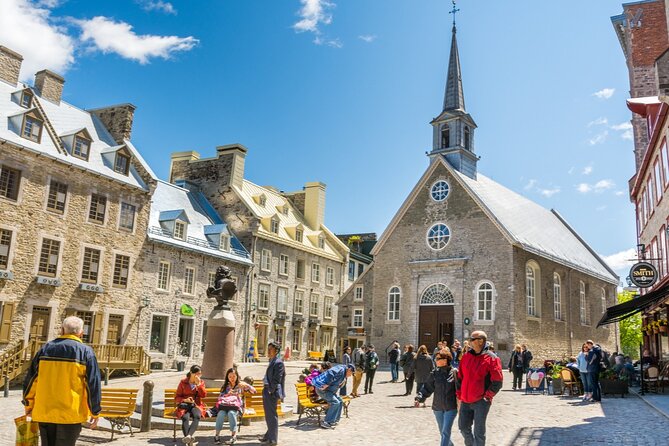
REVIEW · OLD QUEBEC CITY WALKING TOURS
Old Town Quebec Secrets: Private Exploration Game and Tour
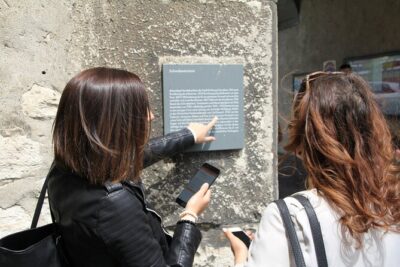
Riddles turn Old Quebec into a walk. This private exploration game uses the Questo app to guide you past major landmarks while you solve look-around challenges. What makes it especially handy is the offline setup, so you can play without internet while still getting a structured route.
You’ll also like the flexibility: you can start, pause, and resume whenever it fits your day. And because there’s no physical tour guide, the experience feels more like controlling your own pace, not rushing behind someone.
One thing to keep in mind: the clues and wording can be inconsistent. Some locations and answers may not perfectly match what you see on the street, so expect a bit of trial, and use hints if you get stuck.
In This Review
- Key things I think you will enjoy most
- What this Old Quebec puzzle walk is really like
- Price and time: $9.29 for a tight, useful 90-minute route
- Logistics that actually matter: meeting point, offline play, and no guide
- The route: Tourny Fountain, gates, convents, and the heart of Place Royale
- Stop 1: Tourny Fountain and Mathurin Moreau’s 1853 clones
- Stop 2: Saint-Louis Gate, from French rule to British restrictions
- Stop 3: The old elm tree on Rue Saint-Louis and the cannonball mystery
- Stop 4: Couvent des Ursulines, learning for women and Montcalm’s burial
- Stop 5: Cathedral of the Holy Trinity, an Anglican-first outside Britain
- Stop 6: The public square’s changing names, from market to city hall
- Stop 7: Séminaire de Québec and François de Laval’s big plan
- Stop 8: A monument to Quebec City’s founder by Paul Chevré (1898)
- Stop 9: Place Royale, Champlain’s 1608 permanent settlement
- Stop 10: The Hôtel du Parlement, built 1877 to 1886
- Stop 11: Notre-Dame-de-Québec, parish since 1664, cathedral in 1674, basilica later
- The best moments, plus the one thing that can slow you down
- Who this is best for, and who may not love it
- Should you book Old Town Quebec Secrets?
- FAQ
- Where does the experience start and end?
- How long does Old Town Quebec Secrets take?
- Do I need internet to play the game?
- Is this a private tour?
- What language is the game available in?
- Is there a physical tour guide included?
- Can I start the game whenever I want after booking?
- What if my group is larger than 15 people?
- Is it free for kids?
- Is there a phone ticket?
Key things I think you will enjoy most
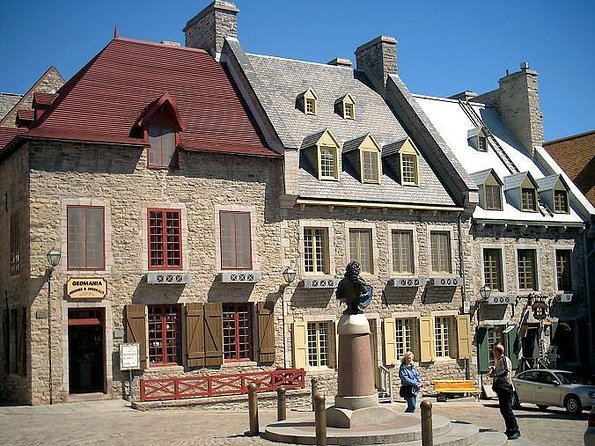
- Offline game play without needing data or internet
- Private, on-your-own-group format for a more relaxed pace
- Look-around challenges that push you to notice details you might miss
- Flexible timing with the ability to start, pause, and continue later
- Good value at about $9.29 per person for a structured 90-minute walk
- Family-friendly pricing, with kids noted as free
More walks inside the walls of Old Quebec
- Quebec City Walking Tour★ 5.0 · 4,716 reviews
- Quebec City: Guided Tour of Fairmont Le Château Frontenac★ 4.7 · 3,027 reviews
- Québec City: Guided Sightseeing River Cruise★ 4.4 · 3,000 reviews
- Half-Day Trip to Montmorency Falls and Ste-Anne-de-Beaupré from Quebec city★ 4.0 · 2,718 reviews
What this Old Quebec puzzle walk is really like
This is a private exploration game built around the streets of Old Quebec. Instead of a scripted lecture, you get a sequence of stops, and at each stop you search your surroundings to answer the prompt. Then you move to the next spot. It’s sightseeing with homework, in a fun way.
I like the mindset this creates. Old Quebec can feel busy and photo-focused, but the game forces you to slow down just enough to read the clues in context, like street corners, facades, and the small weird details locals mention. You’re not just looking at buildings. You’re trying to figure out what the city is showing you.
Because it’s a mobile experience with a mobile ticket, the pacing is yours. If you’re the type who wants 10 minutes to stand in one place, you can. If you’d rather keep moving, you can do that too.
And since it’s offered in English and most people can participate, it’s a straightforward choice for mixed trip styles, as long as you are comfortable following step-by-step directions on your phone.
Price and time: $9.29 for a tight, useful 90-minute route

At $9.29 per person with an approximate 1 hour 30 minutes duration, this isn’t priced like a deep, multi-hour tour. It’s priced like a “best use of time” activity.
That matters in Quebec City. You can easily spend a full day here, but most people arrive with limited energy or a plan that includes meals, views, and maybe other paid activities. A 90-minute game slot is easy to plug into the middle of your day. You also get a route that hits both famous names and some spots people walk past without paying attention.
It’s also one of those rare deals where the format supports solo pacing. You’re not paying for a person to entertain you. You’re paying for a self-guided structure that turns ordinary walking time into something goal-oriented.
For families, the value gets even better. The experience notes that kids are free, which can make it one of the cheapest ways to keep everyone moving without buying extra adult tickets.
Logistics that actually matter: meeting point, offline play, and no guide
You start at 3004 Av. Honoré-Mercier, Québec, QC G1A 1A2, and the experience ends at Rue des Pains Bénits, Québec, QC G1K. The route is guided step by step to Place Royale using the Questo app.
A big practical win is the offline design. You do not need internet to play the city game. That’s helpful in a dense historic area where reception can be unpredictable, or if you’re trying to conserve your plan data.
This is also listed as a private tour or activity, meaning only your group participates. If your group is larger than 15 people, the guidance is to make multiple bookings.
One more practical note: there is no physical tour guide included. So instead of meeting someone in person, you’ll be following prompts on your phone. That’s great if you enjoy independence. It can be less ideal if you want real-time explanations, backstory that goes off-script, or someone to instantly clarify when you’re confused.
More puzzles played out on the street
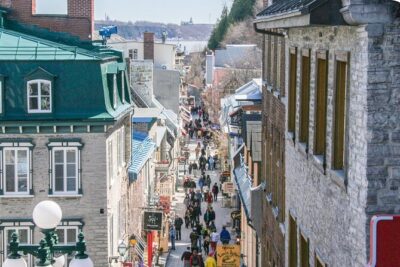
The route: Tourny Fountain, gates, convents, and the heart of Place Royale
The game breaks your walking into a set of landmark stops. At each one, you’re asked to look around to find the answer, then move forward to the next location. The prompts are not just trivia. They’re meant to get your eyes on the right details.
Below are the stops you should expect to encounter, and what makes each one worth the effort.
Stop 1: Tourny Fountain and Mathurin Moreau’s 1853 clones
You begin with a fountain that has a neat story behind it. Even though it’s described as recently installed in Quebec City, the Tourny Fountain traces back to 1853, when French sculptor Mathurin Moreau designed the work. There were six copies, and one set was exhibited at the 1855 World’s Fair in Paris.
Why this stop works in a puzzle format: fountains are visual magnets, but the interesting part is how many layers are hiding in plain sight. You can use the clue prompts to slow down and study the fountain more like an artifact than a roadside decoration.
If you like architecture and design, this is a good opener. It sets a “look closer” tone that pays off later when the game pushes you toward gates, churches, and monuments with layers of meaning.
Stop 2: Saint-Louis Gate, from French rule to British restrictions
Next up is the history-laced story of Saint-Louis Gate. The first gate dates to the late 17th century under the French regime at its present location. Under the British regime, the army would close the gate doors at night to restrict travel between the city and outlying areas.
In a normal walking day, it’s easy to see a gate as scenery. Here, the game’s look-around approach gives you a reason to focus on how gates controlled movement, trade, and city growth. It’s one of those reminders that a door in a wall can change a whole economy.
Expect the stop to feel more like a clue hunt than a museum visit. If your group likes stories tied to real infrastructure, you’ll probably enjoy this one.
Stop 3: The old elm tree on Rue Saint-Louis and the cannonball mystery
On Rue Saint-Louis, at the corner with Rue du Corps-de-Garde, there’s a tall old elm tree with a weird visual twist. People point out what looks like a large cannonball trapped in its gnarly roots. Calèche drivers slow down to show it to passengers, and curious passers-by often try to understand how it got there and when.
This is the kind of stop that feels like it belongs in a riddle game. The game challenges you to search your surroundings and answer using what you can see. It’s also a stop where the “city detail culture” shows up, because the cannonball is one of those local talking points people share without needing formal signage.
If your group likes playful mysteries, this is a highlight in the best way.
Stop 4: Couvent des Ursulines, learning for women and Montcalm’s burial
Then you reach the Couvent des Ursulines, founded in 1639 and described as the oldest institution of learning for women in North America. Its chapel is where French general Louis-Joseph Montcalm was buried after he died in the 1759 battle that helped decide the fate of New France.
This stop adds weight to the walk. After earlier landmark details and street-level oddities, you’re in a place connected to education and wartime consequences.
The game format makes it easier to stand in front of a serious site without feeling like you need a full lecture to appreciate it. The prompt nudges you to observe and connect the visible setting to the story: learning, faith, and the aftermath of conflict.
Stop 5: Cathedral of the Holy Trinity, an Anglican-first outside Britain
The Cathedral of the Holy Trinity is next, and it has a specific claim to fame. In 1804, it became the first Anglican church built outside Britain. It’s also a National Historic Site of Canada (1989).
The cathedral is described as designed in neoclassical Palladian style, modeled after St Martin-in-the-field Church in Trafalgar. That architectural lineage is the kind of thing you’d miss if you were only taking photos. In a clue-driven walk, you’re more likely to notice the style cues because the game pushes you to look for answers.
If you like architecture and comparing styles across countries, this stop earns its place on the route.
Stop 6: The public square’s changing names, from market to city hall
You’ll also pass through the area that has been known under several names: Grande Place, Grande Place de la Haute Ville, and Place du Marché. In 1900, it was renamed Place de l’Hôtel-de-Ville after the construction of city hall. The area was also called place Notre-Dame and place de la Basilique until the middle of the 20th century.
This is one of those stops where the game turns history into something practical. Instead of treating the square like a generic open space, the clue asks you to connect what you see with how the city rebranded itself over time.
Think of it as Quebec City adjusting its identity as institutions changed. Market square, civic space, religious naming, all layered into one walk.
Stop 7: Séminaire de Québec and François de Laval’s big plan
Next is the Séminaire de Québec, a society of Catholic priests founded in 1663 by François de Laval, who later became the first bishop of Quebec. The stated purpose was to train priests, evangelize Aboriginals, and administer the parishes of the colony as a whole.
This stop is helpful because it explains how Quebec City functioned beyond churches and streets. It points to the organizational engine behind religious life.
In puzzle-tour mode, the value is that you’re not just reading a plaque. You’re searching the surroundings for the answer and learning the context as you move, which tends to make the story stick.
Stop 8: A monument to Quebec City’s founder by Paul Chevré (1898)
Then you’ll come across a monument created in honor of the founder of Quebec City, described as a work by Paul Chevré, inaugurated in 1898. This is another stop where the game’s look-around challenge likely directs your attention to the details you might otherwise walk past.
Monuments can feel like background noise on vacation. Here, you get a reason to treat it like a clue, not decoration. If your group likes figuring out what each element of a statue or monument is communicating, this will click.
Stop 9: Place Royale, Champlain’s 1608 permanent settlement
At Place Royale, the game lands on what it calls the precise location where Samuel de Champlain built the first permanent French settlement in the Americas. The settlement was erected in 1608, and his first abitation is described as a fort, store, trading post, and residence all in one.
That’s why Place Royale is framed as the cradle of French North America. The key idea to take in here is that this wasn’t just a ceremonial beginning. It was functional, multi-purpose infrastructure that supported settlement, trade, and defense.
If you want the walk to feel like it ends at the heart of the story, this stop is the one. It’s also a strong payoff moment, because earlier stops built up the city’s institutions and buildings, and now you reach the beginning point that ties them together.
Stop 10: The Hôtel du Parlement, built 1877 to 1886
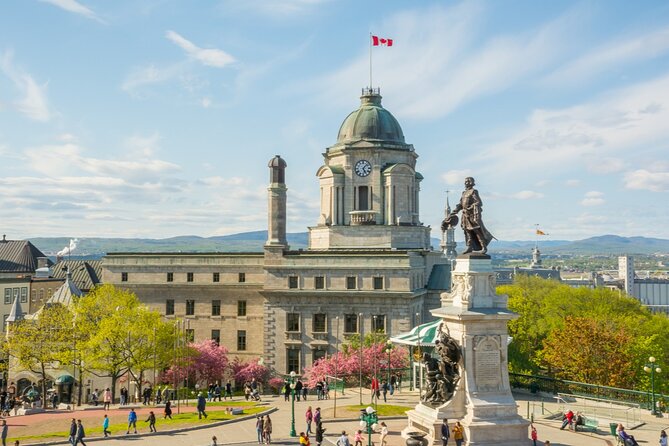
You then head to the Parliament Building (Hôtel du Parlement). It’s described as an eight-floor building and home to the Parliament of Quebec, including the Lieutenant-Governor and the National Assembly. The building was designed by architect Eugène-Étienne Taché and built from 1877 to 1886.
It was inaugurated on September 15, 1896 in the Old Quebec neighborhood. The building slopes downward because it was built on a hill. It was once home to the Jesuit College, also called the Jesuit Barracks, from the 1730s to 1878. The city hall was designated a National Historic Site of Canada in 1984.
This stop is valuable because it connects political power to older religious and educational use. And in a game setting, the prompt can help you notice how a building’s layout fits its site. It’s one of the best examples of Quebec City layering eras rather than replacing them.
Stop 11: Notre-Dame-de-Québec, parish since 1664, cathedral in 1674, basilica later
Your final major stop is Notre-Dame-de-Québec. It’s been the first Catholic parish in North America since 1664. It acquired cathedral status in 1674 when it became the seat of the Diocese of Québec. Two hundred years later, it became a basilica.
The description also notes that its history includes shelling, fires, and multiple reconstructions and renovations.
If you’ve been walking for an hour, this is the right kind of ending. It’s not just a pretty church. It’s a reminder of survival, rebuilds, and the heavy events that shaped the city over centuries.
In puzzle-tour terms, it’s also a satisfying conclusion because the game’s look-around approach gives you a reason to observe the building carefully before you move on to the end point near Rue des Pains Bénits.
The best moments, plus the one thing that can slow you down
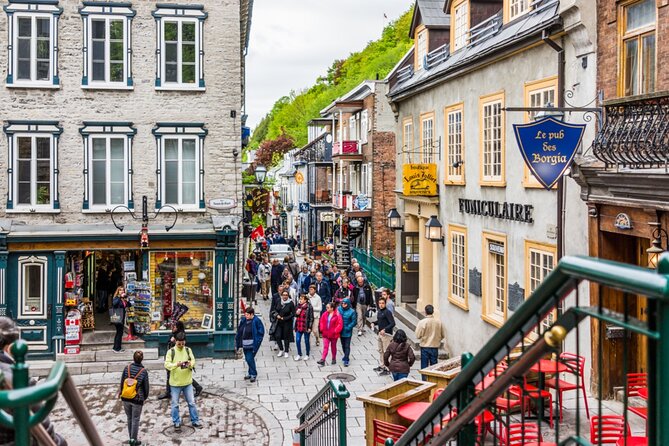
The strongest part of this experience is that it turns sightseeing into active noticing. You’re repeatedly asked to look around and use what you see to answer. That’s why the walk can feel more memorable than a straight “see these places” route.
The other high-value feature is the offline play. When an activity works without internet, it feels easier to trust. You’re not stuck hunting for signal or burning through data just to keep moving.
Now, the drawback to plan around: some clues can be off. There can be outdated prompts if something changes on the street, and some answers can be poorly worded in a way that feels frustrating, especially if you like competing against the clock or against your own logic.
A practical fix is to keep your expectations flexible. Treat it like a puzzle walk, not a perfect scavenger hunt where every sign and viewpoint is guaranteed to match the prompt wording.
Who this is best for, and who may not love it
This is ideal for:
- Couples who like history plus solving riddles
- Families who want a fun way to keep kids engaged for about 90 minutes
- Travelers who prefer self-paced walking and don’t want to wait for a group
- Anyone who likes architecture, gates, churches, squares, and the stories those places carry
It may be less ideal for:
- People who want a physical tour guide doing live explanations and adapting to questions
- Visitors who get upset when a clue is unclear or outdated and want everything airtight
- Groups that dislike phone-based navigation
If your travel style is flexible and you enjoy working out answers while you walk, you’ll probably find this route fits your day well.
Should you book Old Town Quebec Secrets?
I’d book this if you want a low-cost, phone-led way to see Old Quebec with a clear structure. The offline design and private-group format make it easy to use without worrying about internet or crowd flow. And the stop list hits both famous Quebec City markers and the kind of quirky details you don’t usually plan around.
I’d think twice if you strongly prefer a human guide and perfect, up-to-date clues. If your ideal tour is “walk up, read the explanation, move on,” this one might feel more frustrating than satisfying when wording or construction gets in the way.
Overall, for about $9.29 per person and roughly 1.5 hours, it’s a good value choice when you want more from your walking time.
FAQ
Where does the experience start and end?
It starts at 3004 Av. Honoré-Mercier, Québec, QC G1A 1A2, Canada, and ends at Rue des Pains Bénits, Québec, QC G1K.
How long does Old Town Quebec Secrets take?
The duration is listed as approximately 1 hour 30 minutes.
Do I need internet to play the game?
No. You can play offline and you do not need an internet connection.
Is this a private tour?
Yes. It is listed as a private tour/activity, meaning only your group participates.
What language is the game available in?
The experience is offered in English.
Is there a physical tour guide included?
No. A physical tour guide is not included. You follow instructions through the Questo app.
Can I start the game whenever I want after booking?
Yes. The experience can be played anytime after booking without rescheduling.
What if my group is larger than 15 people?
If your group is larger than 15 people, you should make multiple bookings.
Is it free for kids?
Yes. It is listed as free for KIDS.
Is there a phone ticket?
Yes. The experience includes a mobile ticket.
Just Your Group





Puzzles Played on the Street

Inside the Walls of Old Quebec



Just off the notebook: recent Quebec City write-ups
- Quebec City: Historic District Walking Tour (2h)
★ 5.0 · 4 reviews - Quebec City: Fat Bike Guided Tour
★ 4.7 · 4 reviews - Quebec City Photo Tour
★ 5.0 · 5 reviews - Experience île d’Orléans and the falls with a local guide
★ 4.5 · 5 reviews - Private Québec City walking tour with Lenny.
★ 5.0 · 5 reviews - Heritage Upper Town E-Bike Tour
★ 5.0 · 6 reviews
Old Quebec City Walking Tours, compared.
 ★ 5.0Quebec City Walking TourFrom $304,716 reviews
 ★ 4.7Quebec City: Guided Tour of Fairmont Le Château FrontenacFrom $193,027 reviews
 ★ 4.4Québec City: Guided Sightseeing River CruiseFrom $473,000 reviews
 ★ 4.0Half-Day Trip to Montmorency Falls and Ste-Anne-de-Beaupré from Quebec cityFrom $702,718 reviews
 ★ 4.5From Montreal: Quebec City and Montmorency Falls Day TripFrom $362,669 reviews
 ★ 4.8Old Quebec City: Grand Walking Tour with Private OptionFrom $292,609 reviews
 ★ 4.0Quebec City and Montmorency Falls Day Trip from MontrealFrom $362,437 reviews
 ★ 4.6Quebec City: Montmorency Falls with Cable Car RideFrom $192,392 reviews
Browse the lists this tour appears in