
REVIEW · CAPE BRETON & THE CABOT TRAIL
Cabot Trail: a Smartphone Audio Driving Tour
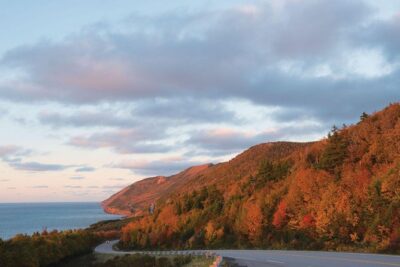
A road trip, but with a brain. This Cabot Trail smartphone audio drive turns long stretches of Cape Breton scenery into a guided route with history, nature, and practical stop prompts you can follow at your own pace. It is also one of those rare deals where you buy once per vehicle, then everyone in your car can listen.
What I like most is the hands-free feel of the experience once it is set up, plus the way the narration points you toward pull-offs and short walks you might otherwise miss. The price is low enough that it does not feel like a big “tour purchase,” even for a single day on the trail.
One thing to watch: the tour depends on doing an initial download over a decent connection. If your setup is incomplete or your device struggles with spotty coverage, some audio cues may act up.
In This Review
- Key highlights you will actually use
- Price and logistics you should understand up front
- The setup that makes or breaks the experience
- Stop by stop: Bras d’Or Lake, Bell, and the mining stories
- Waterfalls, brooks, and the highland rhythm of stopping
- Cape Smokey viewpoints, Ingonish, and whales without the stress
- Acadian paths, the Skyline-style views, and short walks that fit most cars
- Southbound Cape Breton: bays, fault lines, and ocean lookoffs
- Whale-watch country, moose spots, and ocean views you can time right
- The Acadian country ending: churches, mines, and the last look
- Who this tour is best for
- Should you book the Cabot Trail smartphone audio tour?
- FAQ
- Do I need cell signal or data during the tour?
- How many people can listen with one purchase?
- How long should I plan for the drive?
- Where does the tour start and end?
- What do I need to bring?
- What language is the tour in?
Key highlights you will actually use
- One purchase per vehicle means the cost stays friendly, even with a group in one car
- Download once, listen later: after setup, you should not need signal or data during the drive
- GPS-triggered narration keeps you from constantly checking your phone while driving
- Stop-by-stop structure with suggested pull-offs, viewpoints, and short trails
- Bell cues, quizzes, and humor make the drive feel more like guided travel than a dry narration
- Revisit anytime since the tour stays yours to keep within Tripvia Tours
More of the Cabot Trail, driven differently
- Cabot Trail Discovery Tour★ 5.0 · 203 reviews
- Cabot Trail: a Smartphone Audio Driving Tour★ 4.5 · 118 reviews
- Shared Cruise Excursion – “Mini” Cabot Trail★ 4.5 · 58 reviews
- Fortress of Louisbourg Driving Tour from Sydney Nova Scotia★ 3.0 · 38 reviews
Price and logistics you should understand up front
At $9.00 per group (up to 15 people in your vehicle), this audio tour is built for families, friend trips, and road-trippers who want more than a bare map. The value comes from the format: you bring your own car, and you get a guided route without paying per person like you would with most live tours.
Plan for 4 to 5 hours on average, but the real point is that the tour is not a sprint. You can take as long as you like, stop longer when a view catches your eye, and come back later to re-drive parts you want to repeat. That flexibility matters on the Cabot Trail because weather, wildlife sightings, and your own curiosity will steer your timing.
On setup day, you will need a good mobile or WiFi connection to download everything first. The tour states that after that initial download, no signal or data is required during the experience. Translation: you are meant to download, then head into the stretches where cell service can be spotty, without worrying that the guide will cut out.
The setup that makes or breaks the experience
Most of the friction people run into is not about the narration itself. It is about getting the app ready before you hit the trail.
Here is how I recommend you do it:
- Download the tour while you have a reliable WiFi or mobile connection.
- Run through the starting tutorial or first stop so you understand how the audio cues work and what to listen for.
- Give yourself a few minutes at the very beginning to test playback before you start cruising.
Why the extra care? On a route like Cape Breton, the tour area includes long scenic stretches where coverage can be inconsistent. If your download is incomplete, you can end up with stop audio that will not play smoothly or does not advance the way you expect.
Also, you are using your own smartphone or tablet, and you are driving your own vehicle. The tour is truly “in your car,” not “meeting a guide at a van.” If you like the idea of learning while you drive and pulling over only when the guide tells you, this format will fit well.
A final practical note: some people find that audio cues do not automatically advance in every situation. If that happens, you can still follow along using the map and manually start the stop audio when needed. That turns small app hiccups into a minor inconvenience instead of a trip-killer.
Stop by stop: Bras d’Or Lake, Bell, and the mining stories
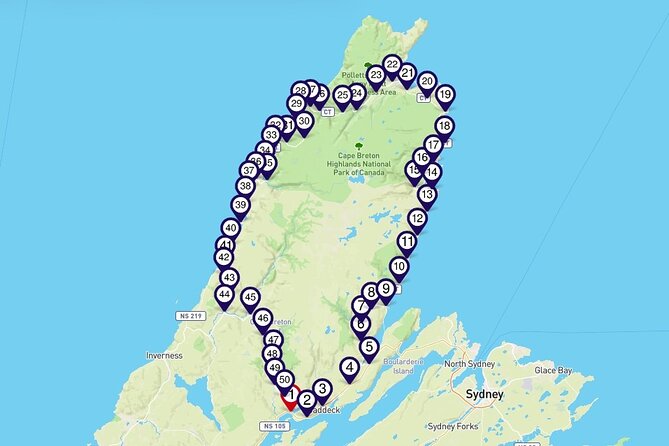
Your drive starts at Buckwheat Corner, NS (B0E 1B0). From there, the tour quickly sets the tone: you get just enough geology, culture, and place-based storytelling to make you look twice at what you are seeing through the windshield.
Early on, you will get glimpses of Bras d’Or Lake, a long, 90 km body of water shaped like three fingers reaching into northern Cape Breton. This is the kind of detail that changes how you view a shoreline. Instead of “water on the side of the road,” you start noticing how the lake’s shape affects where communities formed and where you might spot bays and coves.
Next, you hear Alexander Graham Bell and why there is a museum dedicated to him nearby. Even if you do not pop into the museum, the narration gives you context for why this name matters here. It helps you understand that Cape Breton is not just about dramatic views, it is also about inventors and local stories tied to big ideas.
Then the tour turns to work and settlement: you will hear about the Plaister Mines and what they were mining, and you will get the story of the Scots and their impact on the region. If you like human history paired with scenic stops, this section is a good mix. The drive feels like it is connecting “what you see” with “why it is here.”
Waterfalls, brooks, and the highland rhythm of stopping
A big part of why people enjoy this tour is how often it encourages short breaks. After the early cultural and industrial stories, you get more of the natural world, with stops designed for quick parking, a viewpoint, or an easy walk.
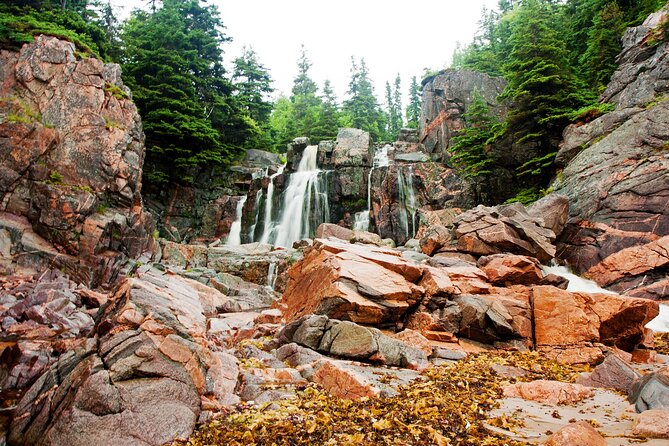
One stop highlights a pretty spot where brooks meet and flow into the cove. If you are a waterfalls person, the tour points you toward waterfalls along Goose Cove Brook that are described as easily accessible. This is exactly the kind of guidance that saves time. Instead of searching blindly for “waterfall trails,” you know there is a good chance you can reach one without a major hike.
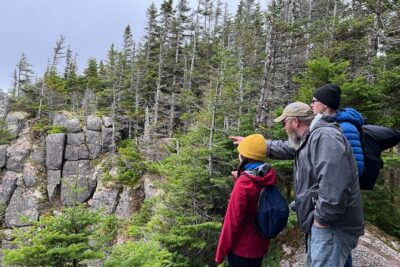
You will also reach the North River Wilderness Area, described as protecting over 5,000 hectares (about 12,000 acres) of highland plateau and rugged river valley. The tour does not just toss out a statistic. It sets you up with a sense of scale, then gives you a reason to pause and consider that this part of Cape Breton is protected land with trails for different levels.
As you keep moving, the narration shifts into a “choose-your-own-break” mode. You get the sense that you can either stretch your legs on easier trails or browse shops when you want a break from walking.
Then comes Plaster Provincial Park, with narration tied to driving along the edge of the park. The goal is to help you read the surroundings: what you are seeing is not random scenery, it is a protected area with features worth understanding as you roll by.
Cape Smokey viewpoints, Ingonish, and whales without the stress

When the tour hits Cape Smokey, it does it in a practical way. You are told there is a pull-off for a panoramic ocean view before heading up. That “pause before the climb” moment matters because it turns a road segment into a planned viewpoint stop rather than a rushed arrival.
On top, you reach the entrance to Cape Smokey Picnic Park, where you can expect picnic tables, flush toilets, and scenic lookouts. That is not just comfort, it helps you plan a real stop if you have kids, if you need a restroom break, or if you want to take photos without scrambling for a place to land.
From there, the tour focuses on Ingonish, described as a cluster of five villages at the gates of Cape Breton Highlands National Park. The storytelling here connects the road to the national park experience: you are entering a place where fresh and salt water beaches show up, and where the scenery gets properly dramatic.
The narration also covers Mi’kmaq ties to the area through the story of two harbours benefiting communities for over 9,000 years and still doing so today. If you care about cultural context, this is one of the more grounded segments because it is time-scale oriented, not just “heritage facts.”
You will also get a stop themed around trails, whales, golf, and goats. Even if you are not into every activity, that mix signals something important: this is not a one-note scenery drive. It is a place where wildlife watching, walking, and community life overlap.
Later, the tour takes a “what you can do here” approach for the national park area, including details for camping, hiking, beaches, and waterfalls. It even frames the ecosystem idea using the line that the park is where mountains meet the sea, with glaciers and rivers shaping the terrain and supporting animals found nowhere else in Nova Scotia.
Acadian paths, the Skyline-style views, and short walks that fit most cars

As you move toward the scenic high points and the next communities, the audio tour leans into “stop-worthy” moments that many people would otherwise pass while staring only at the road.
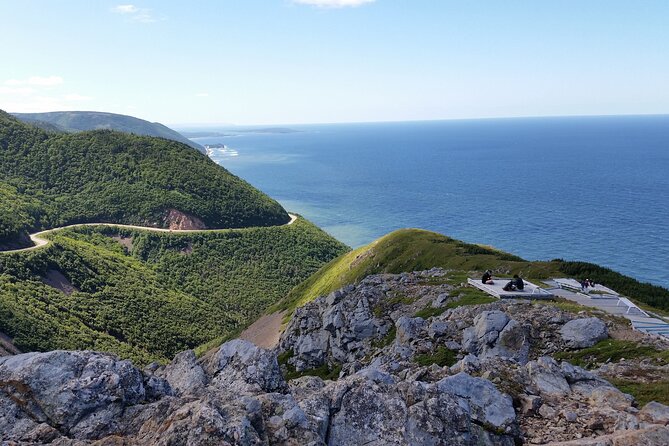
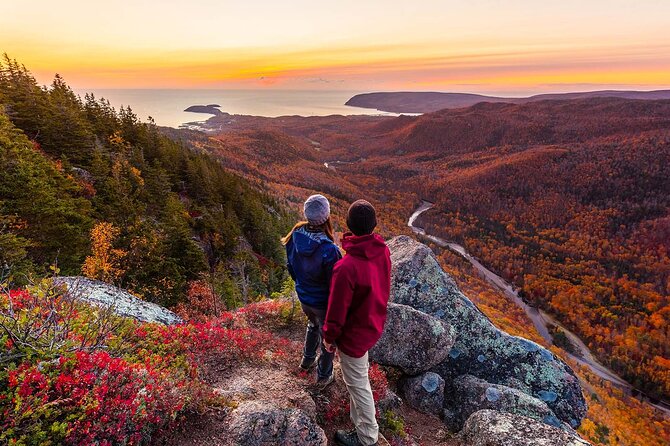
One highlight: the tour points you to an easy walk that matches the feeling of postcard views, linked to the end of the Skyline trail and its headland cliff with dramatic views of the Cabot Trail winding along French Mountain. The description emphasizes that the path is well groomed and rated as an easy walk, which is useful because the Cabot Trail offers a lot of “wow” but also a lot of “can my knees handle this today?” guidance. Easy means you can say yes more often.
Then comes one of the tour’s most story-forward sections: a walk through history tied to Acadian families. You will hear that at one time 30 Acadian families lived in the area, and many were refugees after the great expulsion of 1755 in Nova Scotia. It is the kind of context that turns a trail into a timeline you are walking through.
The narration also describes Le Buttereau, French for “little hill,” where seven Acadian families once lived. If your group likes stories with names, dates, and human outcomes, this will land.
You will then reach the Cheticamp River, described as the western entrance to the National Park, with a campground and nearby trails. The audio mentions le chemin du Buttereau here and gives you a reason to look at how the river meets the tidal estuary, including a view of gravel and sand sweeping from the red bluffs and almost cutting the river off from the sea.
In this general area, the tour also frames Cheticamp as one of the Acadian capitals of the world, with a museum, restaurants, whale watching, and an excellent golf course. It then points you toward Plage St. Pierre on Cheticamp Island for lounge time by the water, plus a Mi-careme segment where you can learn about the tradition and even visit a center to make your own mask if you have time.
Southbound Cape Breton: bays, fault lines, and ocean lookoffs

Later in the drive, you get even more place names that help you orient yourself when you are scanning for pull-offs. One stop features Aspyr Bay, described as having a red sand bar that protects the large South and North Aspy Bays. That red-sand detail is useful, because it makes you more likely to pull over and confirm what you saw on the shore.
The narration then points to the Polletts Cove-Aspy Fault Wilderness area, described as marking the collision of three continental plates. If you are curious about earth science, this is a fun “why this terrain looks like this” moment. If you are not, it still gives you a mental hook, so the fault line idea becomes part of your viewing rather than random trivia.
The tour also points you toward what it describes as the most accessible waterfalls in the park, with an easy, short walk. That kind of “low friction hike” guidance is a real win on the Cabot Trail, where you might want multiple small experiences rather than one big commitment.
Then you reach Appalachian-style plateau lookoffs, described as the northern tip of the Appalachian Mountains in eastern North America. The tour tells you to look out from roadside lookoffs, including one that provides views of a giant fault line cutting through highland plateaus.
Other smaller walks appear in the audio path too, including:
- Lone Shieling, a replica of an old Scottish crofter’s hut, with interpretive panels and a roughly 15 minute walk through sugar maples
- MacIntosh Brook trail, described as about a 30 minute walk suitable for families and even for a dog, following a brook to a woodland waterfall
These walk times help you plan. You can keep your trip enjoyable even if you have kids, older relatives, or simply a day where you do not want to be hiking for hours.
Whale-watch country, moose spots, and ocean views you can time right
By the time you reach Pleasant Bay, the tour calls it the whale watching capital of Cape Breton. The key here is not to treat it like a guarantee. The more useful angle is that this stop trains you to look for marine life where locals and nature-focused visitors watch most often.
The audio also gives you a Gulf of St Lawrence view from a lookoff where you can stop and catch your breath. That breathing room is part of why audio driving tours work. When you know there is a planned viewpoint, you are less likely to “just keep driving and hope the next view is better.”
Later, you will also hear about Fishing Cove Trail and the view from its entrance, including mountain headlands swooping down to the ocean. Another stop mentions a moose-related spot with an explanation for why moose are common there and what they feed on in forest herbs and aquatic plants.
You will then reach a French Lake pull-off described as showing a highland lake surrounded by Boreal forest. That mix of water plus forest is part of the Cabot Trail’s appeal, and the narration helps you slow down enough to notice the details.
Finally, the audio comes back to the idea of views that look like they were shot for postcards. The Skyline trail headland cliff is the big one, and it is supported by the fact that the walk is rated easy.
The Acadian country ending: churches, mines, and the last look
As the tour moves toward the south end of the drive, it continues building on cultural place names and practical stop ideas.
You will hear about Le Buttereau again in context with the surrounding area, and then you roll into a set of stops tied to coastal communities and regional geography, including Cape Breton Trough and the Gulf of St Lawrence.
There is a Margaree Harbour crossing where you might think it is a lake, but the narration describes it as an estuary around half a mile (almost 1 km) wide. Then the tour highlights what you might see from the East Margaree Crossing bridges along the valley floor, including a mention that you might even spot someone fishing in waders.
Toward the end, you get a few “quirky but memorable” stops:
- a Margaree Salmon Museum and not far from it a fish hatchery
- a picnic park alongside the road with views of low mountains across the lake
- an old mine area in the hills where you get a prompt to guess what was mined there
- two unique churches side by side, described as white clapboard and grey spires, framed like fraternal twins
That combination of wildlife, food stops, and small surprises is a big reason audio tours work. They give you a reason to stop even when the road looks like it could keep going forever.
Who this tour is best for
This is a strong fit if you:
- want a value-priced guide for a drive day
- like learning while you move, especially with history and nature paired together
- prefer pull-over guidance and short walk ideas
- travel with a group in one vehicle, since one booking covers up to 15 people
- appreciate not touching your phone while driving, since GPS-triggered narration is the point
It might be less ideal if you:
- hate doing any tech setup or downloading content ahead of time
- need fully automatic playback in every scenario and do not want to troubleshoot when the audio does not advance
- are planning to rely on cell service during the drive without downloading first
Should you book the Cabot Trail smartphone audio tour?
I think this one is an easy yes, as long as you treat setup like part of the trip. The $9 per vehicle value is excellent, and the route is packed with specific places: Bell, mining, Mi’kmaq harbour stories, waterfalls you can reach easily, lookout points, and walkable stops like Lone Shieling and MacIntosh Brook. The best part is that it is built for your pace, not a tour bus schedule.
Book it if you want your Cabot Trail day to feel guided, but still yours. Skip it if you know your phone or connection setup is unreliable and you cannot download properly before you leave.
FAQ
Do I need cell signal or data during the tour?
No. The tour says you do not need signal or data during the experience after you complete the initial download.
How many people can listen with one purchase?
One booking is good for a group in one vehicle, up to 15 people. Only one tour booking per vehicle is needed.
How long should I plan for the drive?
Plan for about 4 to 5 hours on average, though you can take as long as you like since there are no time constraints.
Where does the tour start and end?
It starts at Buckwheat Corner, NS B0E 1B0, and it ends back at the meeting point.
What do I need to bring?
You need your own smartphone or tablet. Transportation is also not included, so you drive your own vehicle.
What language is the tour in?
The tour is offered in English.
The Cabot Trail, Driven Differently


Just off the notebook: recent Cape Breton Island write-ups
- Sydney City & Coastline Tour
★ 4.5 · 4 reviews - Cabot Trail Jeep Adventure – Cruise Excursion
★ 5.0 · 5 reviews - Private Port of Sydney-Cape Breton Highlands ATV Excursion
★ 4.5 · 5 reviews - Cape Breton Jeep Adventure (4hr)
★ 5.0 · 6 reviews - Cabot Trail Ingonish Beach & Green Cove Adventures in Cape Breton
★ 5.0 · 6 reviews - East Cabot Trail Coastal Drive and Cape Breton Highlands
★ 4.0 · 8 reviews
Cape Breton & the Cabot Trail, compared.
 ★ 5.0Cabot Trail Discovery TourFrom $131203 reviews
 ★ 4.0Cabot Trail Bus Tour for Cruise ExcursionFrom $129101 reviews
 ★ 4.5Blackwood Tours: Highland Village, Baddeck, Bell Museum TourFrom $14082 reviews
 ★ 4.4Highlands National Park: Cabot Trail TourFrom $13063 reviews
 ★ 4.5Shared Cruise Excursion – “Mini” Cabot TrailFrom $14958 reviews
 ★ 4.5Explore Cabot Trail and BaddeckFrom $12555 reviews
 ★ 3.0Fortress of Louisbourg Driving Tour from Sydney Nova Scotia38 reviews
 ★ 4.0Blackwood Tours: 6 Hour Cabot Trail Tour in Cape Breton, NSFrom $13035 reviews
Browse the lists this tour appears in