
REVIEW · WALKING TOURS
Ancient Trees of Vancouver Walking Tour
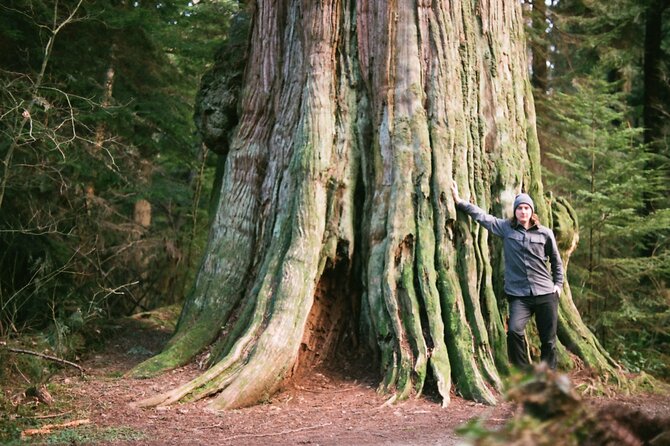
Stanley Park hides living time machines. On this 3-hour walk, Stanley Park becomes a classroom, with big-tree sightings and archive-style storytelling that connects the forest to Coast Salish life over thousands of years.
Two things I liked a lot were the way Colin Spratt (a BC Big Tree Committee member) leads the group, and the use of old maps, 120-year-old postcards, and photographs to explain how this place changed. You are not just looking at trees, you are learning how they fit into ecology and human history.
One possible drawback to weigh: this is a walking tour with no pick-up or drop-off, and it starts at Ferguson Point. If you do not want to get yourself there, or you hoped for transport included, plan ahead.
In This Review
- Key points to know before you go
- Stanley Park’s ancient trees, explained in a way that sticks
- Your guide: Colin Spratt and why the stories feel grounded
- Getting there at Ferguson Point, then staying on easy park trails
- The 3-hour itinerary: one main stop, but many layers of learning
- Stop: Stanley Park old-growth giants and the archive story trail
- What you learn about the trees as you encounter them
- The ancient-tree lineup: cedar, Douglas fir, and Canada’s maple claim
- Beyond botany: Coast Salish history and cedar as the tree of life
- Ecology lessons you can spot: nurse logs, fire resilience, and regeneration
- Why the archival materials matter more than you think
- Price and value: $56.33 for 3 hours with a big-tree specialist
- Who should book this and who may want a different plan
- Should you book Ancient Trees of Vancouver?
- FAQ
- How long is the Ancient Trees of Vancouver walking tour?
- Where does the tour start?
- How many people are on the tour?
- What is included in the tour price?
- Do I need a ticket for Stanley Park?
- Is the tour offered in English?
- Is there pick-up or drop-off?
- Can I bring a service animal?
- What is the cancellation policy?
- When should I expect confirmation after booking?
Key points to know before you go
- Max 10 people: small group size keeps the pace comfortable and questions easy.
- Colin Spratt leads: BC Big Tree Committee member, focused on identifying and conserving big trees.
- Archive visuals: old maps plus 120-year-old postcards and photos make the forest history feel real.
- Big-tree checklist: you’ll see ancient western red cedar, Douglas firs around the 600 to 800-year range, and Canada’s largest known maple tree.
- Ecology lessons on the trail: concepts like nurse logs, regrowth, and hollow-tree habitats are tied to what you can spot.
- Coast Salish context: cedar is discussed as a tree of life, with uses for daily living and long-term survival.
Vancouver at walking pace, a few more routes
- Gastown Historic Walking Food Tour★ 5.0 · 1,863 reviews
- Vancouver Lost Souls of Gastown Walking Tour★ 5.0 · 1,273 reviews
- A Wok Around Chinatown: Culinary and Cultural Walking Tour Led by a Chef★ 5.0 · 610 reviews
- The Forbidden Downtown and Gastown Walking Tour★ 5.0 · 476 reviews
Stanley Park’s ancient trees, explained in a way that sticks
This tour is built for people who love nature, but it also works if you are more of a curious observer. You walk through Stanley Park and keep getting “how is this even still here?” moments, then you learn the science and the human story behind those moments.
What makes it especially effective is the mix of what you see and what you learn. You are guided to specific ancient giants, then the guide uses old maps and photographs to help you understand how the area looked and how it was used long before it became the park most people know today.
Your guide: Colin Spratt and why the stories feel grounded
Colin Spratt, the tour guide, is not doing a generic narration. He is part of the BC Big Tree Committee, and his passion shows in the way he connects tree age, shape, and survival to what is happening in the ecosystem right now.
In the strongest moments of the tour, Colin talks about trees as living systems, not just impressive objects. For example, you learn why old growth matters, what threats exist today, and why conservation is not a slogan, it is practical work tied to real trees and real habitats.
Getting there at Ferguson Point, then staying on easy park trails
The tour starts at Ferguson Point, 7501 Stanley Park Dr. It ends back at the meeting point, so you will be doing a loop-style walk rather than a point-to-point hike.
The pace is one of the quiet strengths. The trails are described as easy walking trails, which matters because it lets you focus on the details: bark texture, tree form, and the little ecological clues the guide points out. Since the group stays small (maximum 10), you do not have that common problem of being pushed along.

The 3-hour itinerary: one main stop, but many layers of learning
This experience is built around a single centerpiece: Stanley Park. Even though it is one stop, it does not feel like a quick scan of famous trees. The time is used to connect the trees you see to the forest history you would otherwise miss.
Here is how that plays out in practice.
Stop: Stanley Park old-growth giants and the archive story trail
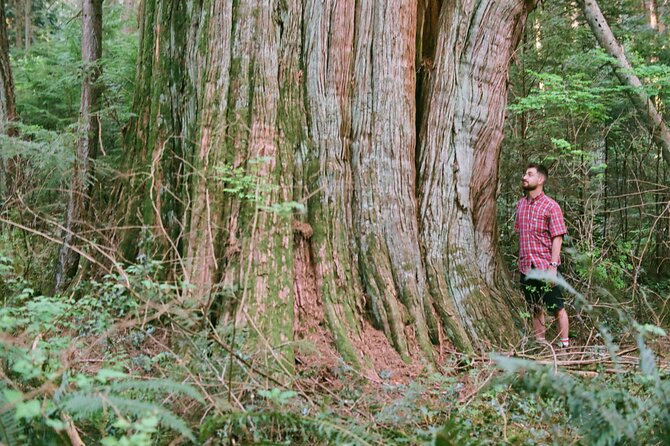
You begin in Stanley Park and follow the guide along park trails toward the most impressive ancient trees in the area. The highlights include ancient western red cedar, towering Douglas firs, and the largest known maple tree in all of Canada. You also learn about the ecological importance of old-growth forests and the threats those forests face today.
Then the tour shifts from “look at that tree” to “why does this tree exist here.” Colin uses old maps, plus 120-year-old postcards and photographs, to show how people have viewed and interacted with this land over time. That visual approach helps you understand that Stanley Park was shaped by human choices, not just weather and time.
What you learn about the trees as you encounter them
Several big-tree concepts show up on the trail and turn into real observations.
First is the idea of nurse logs. You learn how fallen trees can nurture new life, so the forest keeps regenerating even when the headline trees are centuries old. It is not just “cool fact,” because it is tied to what you see in the ground layer and how the forest continues to work.
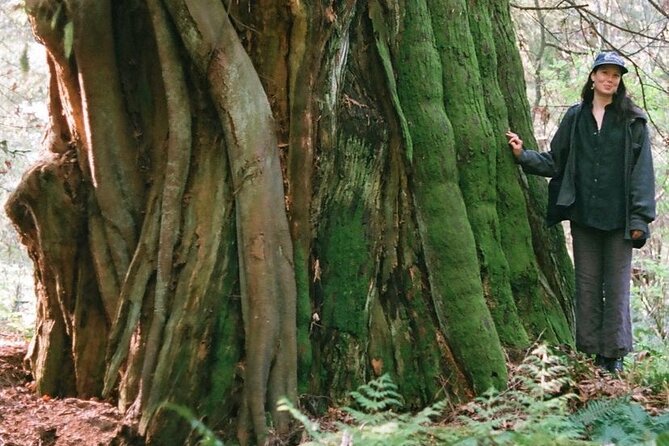
Second is the role of hollow trees. You are shown that many long-lived cedar trunks are hollow, and those hollows can become habitats, including housing for wildlife such as bears (as explained by the guide). That changes how you think about what you see, because a hollow tree is not “damaged,” it is part of the ecosystem’s survival system.
Finally, you learn how the tour frames age and significance. The guide explains tree age estimation and what features suggest age and resilience. Once you hear the logic, you start noticing tree form and structure as clues rather than decoration.
The ancient-tree lineup: cedar, Douglas fir, and Canada’s maple claim
This is the section you will remember afterward, because it is very specific.
You will spend time with ancient western red cedar trees, including very old individuals that Colin refers to as grandfather tree type icons in the way the story is told. You will also see towering Douglas firs, discussed around the 600-year mark in the tour narrative, and around 800 years for some of the featured giants.
The tour also highlights Canada’s largest known maple tree in the context of what Stanley Park protects. It is a clever way to avoid the “everything is cedar” feeling and to show that old-growth value is not limited to one species.
And yes, you do not just view these trees from a distance. The experience includes moments where you can get close and even touch trees nearly a millennium old, which makes the scale feel physical instead of theoretical.
Beyond botany: Coast Salish history and cedar as the tree of life
A standout part of this tour is how the story includes First Peoples history, not as a side note but as a core thread. Colin explains that the area was home to the original Coast Salish inhabitants for thousands of years before it became an urban park.
Cedar is central to this conversation. You learn how cedar was treated as a tree of life, and how it supported daily living and long-term culture. The guide covers how cedar fibers were used for textiles, and how wood and bark played roles in longhouse construction, canoes, clothing, and rope.
One of the most meaningful points is the guide’s emphasis on how cedar use reflects a deeper understanding of the whole tree. You hear about the idea that most of a tree is “dead” material, yet that material is exactly what protects and supports new life in the forest. It is the kind of lesson that makes you see a forest differently the next time you walk near one.
Ecology lessons you can spot: nurse logs, fire resilience, and regeneration
Old-growth forests feel mysterious until someone shows you what to notice. Colin’s approach makes the ecosystem visible through a few key ideas.
He explains how nurse logs support regeneration, so the next generation rises on what looks like decay. He also talks about why cedar tends to resist fire and rot, which helps explain how old trees can last so long in a place that humans have altered around it.
In a particularly practical storytelling moment, you learn how even a small seedling connects to the long life cycle of much older trees. That is useful because it reframes “ancient” as a living process, not just a time stamp.
Why the archival materials matter more than you think
Old maps and postcards can sound like background decoration until you see how the guide uses them. Here, those archive items help you compare past and present and understand why certain trees are still here when so much else has changed.
Seeing how people photographed and described the area over time adds credibility to what you are learning. You start to notice that the story of Stanley Park is not only about nature, it is also about land use, logging pressures in the broader region, and conservation efforts that helped protect old growth.
For me, this is what keeps the tour from feeling like a standard nature walk. The archives make the park’s long story feel connected, instead of random.
Price and value: $56.33 for 3 hours with a big-tree specialist
At $56.33 per person for about 3 hours, this tour is not the cheapest thing you can do in Vancouver. But it also is not trying to be. You are paying for a small group size, a guide with direct big-tree credentials, and a focused Stanley Park experience where the tree stops are the point.
The “value” angle becomes clear when you look at what you get for your time. You get access to the guide’s tree identification skill, plus explanations built around old-growth ecology and human history. You also get that practical advantage of a maximum of 10 participants, so you can ask questions and hear the answers without tuning out.
And because it is a walking tour inside Stanley Park, there is no separate attraction ticket you need for park entry as part of the experience framing. In other words, the money goes toward the guide-led interpretation and the time you spend with the big trees.
Who should book this and who may want a different plan
This tour fits best if you want something different from standard sightseeing. If you are the type who stops to read a plaque, you will enjoy it. If you love forest science, tree structure, or the way ecology connects to Indigenous history, you will likely have a great time.
It may feel less ideal if your main goal is high-tempo urban touring, because this is a 3-hour walk on park trails with emphasis on slow, detailed observation. It also is not a bike tour, so if that is your preferred way to explore Stanley Park, you might want to pair this with another option rather than replace it.
Should you book Ancient Trees of Vancouver?
I think you should book this tour if you want a guided way to see Stanley Park’s old-growth giants and understand them properly. The combination of small-group size, Colin Spratt’s big-tree focus, and the use of old maps and postcards makes the experience feel both practical and memorable.
If you are only doing one nature activity in Vancouver and you want the one that gives you a new lens for looking at trees, this is a strong choice. If you hate walking or dislike structured tours, you might choose differently. But for most people, this is the kind of half-day-level experience that lingers, because you leave with trees that feel like stories you now know how to read.
FAQ
How long is the Ancient Trees of Vancouver walking tour?
The tour runs about 3 hours.
Where does the tour start?
It starts at Ferguson Point, 7501 Stanley Park Dr, Vancouver, BC V6G 3E2, Canada.
How many people are on the tour?
The experience has a maximum of 10 travelers.
What is included in the tour price?
The tour includes an expert guide, a walking tour, and tree-focused highlights such as ancient giant western red cedars and towering Douglas fir trees, plus old maps and 120-year-old postcards and photographs used during the walk.
Do I need a ticket for Stanley Park?
The experience indicates admission ticket is free as part of the tour.
Is the tour offered in English?
Yes, it is offered in English.
Is there pick-up or drop-off?
No pick-up and drop-off is provided at the meeting point.
Can I bring a service animal?
Service animals are allowed.
What is the cancellation policy?
Free cancellation is available up to 24 hours in advance for a full refund.
When should I expect confirmation after booking?
You will receive confirmation at the time of booking.
Vancouver on Foot


Just off the notebook: recent Vancouver write-ups
- Vancouver: Sunset Boat Cruise with Complementary Bubbly
★ 4.3 · 4 reviews - Vancouver: Personal Travel & Vacation Photographer
★ 4.7 · 4 reviews - Vancouver Private & Custom Tour with a Local: Icons & Gems
★ 3.6 · 4 reviews - Vancouver: Fraser Valley and White Rock Wine Tour
★ 5.0 · 4 reviews - Stanley Park EUC & E-scooters loop tour
★ 5.0 · 4 reviews - Capilano Suspension Br+Lake+Dam+Hachery/4in1/CAR/Small GROUP
★ 5.0 · 4 reviews
Walking Tours, compared.
 ★ 5.0Quebec City Walking TourFrom $304,716 reviews
 ★ 4.8Old Quebec City: Grand Walking Tour with Private OptionFrom $292,609 reviews
 ★ 4.5The Original Old Montréal Walking Tour by GuidatourFrom $262,217 reviews
 ★ 5.0Old Montreal Small-Group Walking Tour | Max 10 | by MTL DetoursFrom $442,088 reviews
 ★ 5.0Gastown Historic Walking Food TourFrom $1161,863 reviews
 ★ 5.0Old Quebec Classique Walking Tour with FunicularFrom $421,317 reviews
 ★ 5.0Vancouver Lost Souls of Gastown Walking TourFrom $291,273 reviews
 ★ 4.6Quebec: Crimes of New France Animated Walking TourFrom $20926 reviews
Browse the lists this tour appears in