
REVIEW · BANFF NATIONAL PARK DAY TOURS
Intro to Stand Up Paddleboarding, Banff National Park
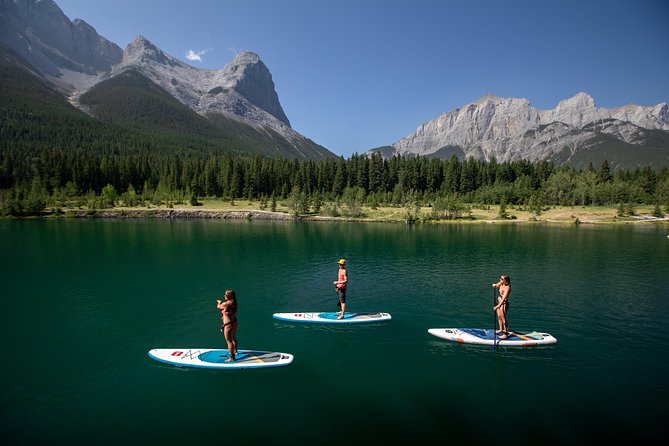
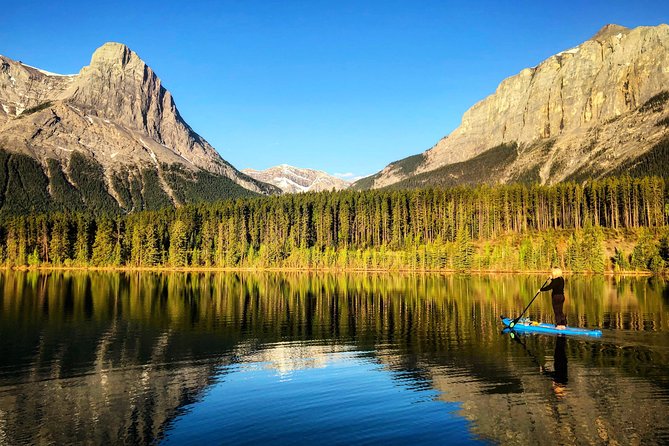
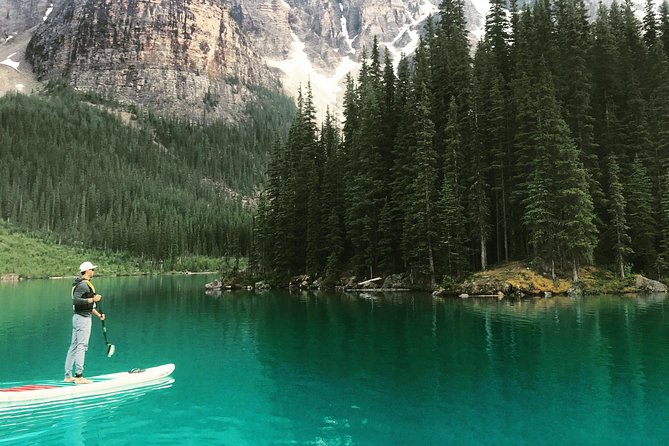
SUP on Johnson Lake feels like Banff for you. This beginner-friendly intro session puts you on Johnson Lake with big mountain views overhead, guided step by step and away from the busiest crowds. It is part workout, part skills lesson, and part scenery time.
I love that the price covers the gear you need to try stand up paddleboarding, including PFDs, a leash, the SUP, and a paddle. And I love how the coaching shows up in real life, with instructors like Maggie and Ryan who keep things calm, safe, and friendly while still pushing you a bit to improve.
One consideration is that the tour runs only with good weather, so plan to be flexible if conditions are poor.
In This Review
- Key things to know before you go
- Entering Johnson Lake, Banff’s calm-water classroom
- The 90 minutes, step by step on the water
- Gear is included, which is where a lot of value hides
- Coaches who keep beginners calm, like Maggie and Ryan
- Small group SUP in Banff: why the cap matters
- What you will actually learn (beyond just standing)
- Price and value in Banff terms
- Meeting point, timing, and how to plan your morning
- Who this SUP intro is perfect for
- Should you book this beginner SUP in Banff?
- FAQ
- How long is the stand up paddleboarding intro?
- What gear is provided?
- Do I need prior SUP experience?
- Where does the tour take place?
- How many people are in the group?
- What time does the activity start?
- Who leads the course?
- What is the cancellation policy?
- Do they provide confirmation after booking?
- What if the tour is canceled due to weather?
Key things to know before you go
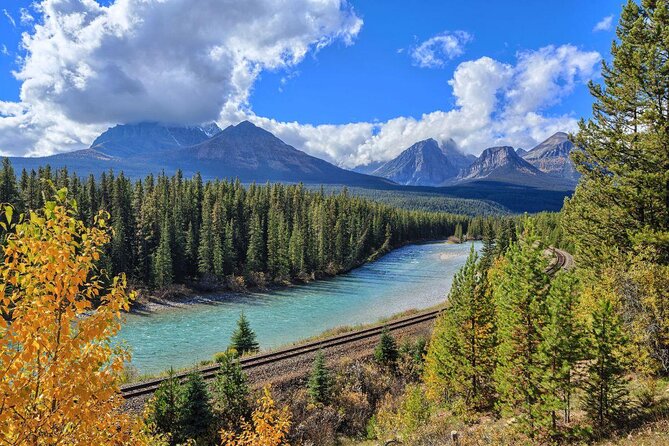
- Johnson Lake is the training ground for your first paddling attempts, with clear water and Banff mountain views.
- All equipment is provided: SUP, paddle, PFD, and leash, so you do not need to rent or guess sizing.
- Paddle Canada certified SUP guides lead every course, with instruction tailored to beginners.
- Small group size keeps it intimate, with a maximum of 6 people (often limited to 5).
- A tight 1.5 hours gets you from basic balance to simple board control.
- The outing uses a mobile ticket and runs from a single meeting point on Johnson Lake Road.
A full day inside the park, arranged a few other ways
- Banff Highlights & Wildlife | Award-Winning Small Group Adventure★ 4.5 · 725 reviews
- Banff National Park Tour with Lake Louise and Moraine Lake★ 4.5 · 692 reviews
- Banff National Park: 1-Hour Bow River Horseback Ride★ 4.6 · 518 reviews
- 1 Hour Bow River Ride★ 4.5 · 429 reviews
Entering Johnson Lake, Banff’s calm-water classroom
Banff National Park has a way of making even simple activities feel cinematic. Johnson Lake is a smart choice for a first SUP lesson because it gives you space to learn without the pressure of busy water lanes or complicated logistics. The water is calm enough that beginners can focus on balance and movement rather than constantly fighting waves.
What makes this setting especially good is how clearly Banff shows up around you. With mountains towering overhead and clear water under you, your brain stops treating paddleboarding like a “test.” It becomes a moving viewpoint, one you control. That matters, because most first-timers are not afraid of standing on the board so much as they are afraid of doing it wrong.
And yes, you can expect a little workout too. Even when the water is gentle, paddling and stabilizing engage your core and legs. The goal here is not exhaustion. It is learning the basics so you leave feeling capable, not wrecked.
The 90 minutes, step by step on the water
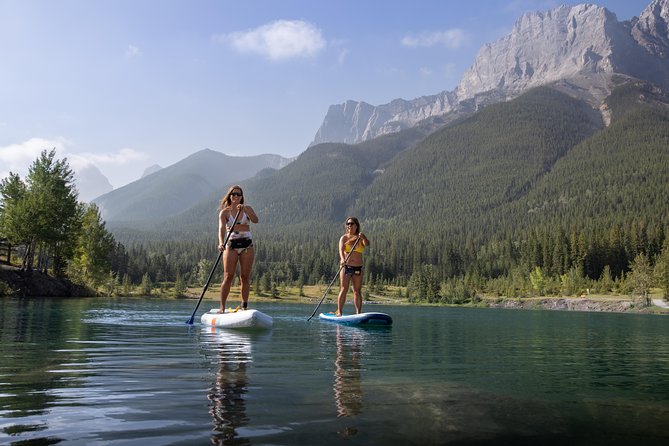
Your course runs about 1.5 hours, and it is paced like a real lesson, not a casual stroll. When the group gathers near Johnson Lake Road, you start by getting set up with the essentials. Then the guide shifts right into skill-building.
Here is the rhythm you can expect:
First, you get the safety basics and water comfort. Even if you have never paddled before, you will cover the essentials that keep things simple and safe. This includes learning how to use the leash and understanding how to stay stable while you find your footing.
Next comes standing and balance. This is usually the biggest mental hurdle for new SUP students, because the board feels different from anything you have stood on. The good news is that the guides teach you in a way that breaks the challenge into small steps. The instruction style reported across the experience focuses on reassurance and patience, so you do not feel like you are being rushed.
After you get more comfortable, you move into basic maneuvering skills. The course is built around general board control, meaning you learn how to move forward and how to make simple changes in direction. It stays beginner-friendly, but it is not “do nothing and float.” You will get enough practice that paddling starts to feel connected to what you are doing with your body.
By the end, the aim is confidence. You are not just surviving on a board. You are participating, standing longer, paddling with more control, and enjoying the views without thinking every moment about falling.
Gear is included, which is where a lot of value hides
At $73.39 per person, this could look like a “just do it” activity. The smart part is that the price actually covers the equipment that usually adds cost and hassle.
You are provided with:
- a PFD
- the SUP
- a paddle
- a leash
That matters in Banff, where renting gear can eat time and budget. When you show up and everything is already sorted, you spend your limited session learning, not preparing. The guide can also fit instruction to the equipment in front of you. That can help you progress faster, because you are not adjusting to a weirdly sized board or an uncomfortable paddle.
From the experience’s overall feedback, equipment condition is also a strong point. People specifically liked that the boards and gear were in good shape, which reduces the “why is this harder than it should be?” frustration that some first-time activities can trigger.
More park gates worth queueing at


Coaches who keep beginners calm, like Maggie and Ryan
The most repeated theme from the experience is teaching quality. Not just the idea of “good instructors,” but the actual way they coach, including patience, comfort, and clear feedback.
Instructors mentioned include Maggie and Ryan, and others such as Brandon and Spencer. The teaching approach that shows up in their style is balanced: encouraging you to stretch your limits while making sure you feel safe. That is the difference between a first-timer who stands up quickly and one who worries the whole time.
You will also notice that the guidance is not purely generic. People liked that instruction felt tailored, with coaching that meets you where you are. If you take a little longer to stand, the pace does not automatically punish you. If you stand early, you still get new skills added so the experience does not stall.
One extra detail worth paying attention to is how much the guide keeps the session moving. A good intro course should feel structured, so you always know what you are trying to learn next. Here, the lesson stays active, with new skills introduced to keep things interesting.
Small group SUP in Banff: why the cap matters
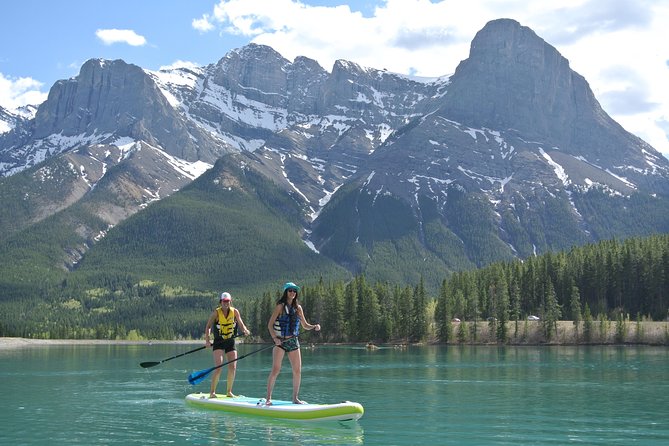
This is built as a small-group experience, with a maximum of 6 people, and it is often limited to 5. That sounds like a minor detail until you think about what paddleboarding requires from an instructor.
SUP basics involve real-time balance corrections. If the group is large, the guide can only check in now and then. With a smaller group, you are more likely to get hands-on adjustments in the moment and clearer coaching on what to change next.
That also helps with family and mixed-experience groups. People noted that everyone in their group, including kids, could stand up for long stretches. Kids and beginners often do best when the guide can help quickly and when the instructor can read the room, spotting who needs a confidence boost and who is ready for the next step.
There is also something psychological here: a small group makes it easier to relax. You can learn without feeling like the slowest person in a crowd. That is a big deal when you are trying a new skill while wearing a leash in open water.
What you will actually learn (beyond just standing)
This is an intro session, so it does not pretend you will become an expert paddler in 90 minutes. But it does give you a working skill set, not just a scenic float.
Expect to leave knowing:
- how to stay safe while on the board (including leash use)
- how to get comfortable standing and maintaining balance
- how to paddle with basic control
- how to maneuver the board with simple direction changes
The key is that the instruction helps your body create repeatable movements. Once you start finding that pattern, you can actually enjoy the water rather than constantly resetting.
And the coaching does not stop after you stand. People liked that instructors kept adding skills, so the session builds instead of repeating the same drill. That is how you get from “I stood up” to “I can paddle and steer.”
Price and value in Banff terms
At $73.39 per person for about 1.5 hours, the cost only feels reasonable if you treat it as a lesson plus equipment plus a top-tier setting.
Here is why the math works:
- Gear is included (PFD, SUP, paddle, leash).
- Instruction is led by Paddle Canada certified SUP guides.
- The group is small, which increases attention.
- You are paddling Johnson Lake in Banff National Park, with mountain views and clear water.
If you already own SUP gear, it still helps because the guide compresses learning time. If you do not own gear, it helps even more because you do not have to sort rentals or compatibility issues.
I would also frame the price as value for confidence. A first SUP outing can be intimidating, and paying for structured coaching can prevent you from leaving frustrated. This course is designed to turn nervous energy into steady progress.
Meeting point, timing, and how to plan your morning
The tour starts at 9:30am and ends back at the meeting point. You meet at Johnson Lake Road, in the Improvement District area near T0L in Alberta.
Why the timing matters: a morning start often means steadier conditions and less crowding around the lake. It also fits the “short and satisfying” format. You are out on the water, you learn the basics, and you still have plenty of day left in Banff.
The experience uses a mobile ticket, and confirmation is received at booking. Service animals are allowed, and the activity is near public transportation, which can make planning easier if you are not driving.
One planning detail to remember is that your course depends on weather. If it is canceled due to poor conditions, you should be offered a different date or a full refund, depending on how the operator handles it.
Who this SUP intro is perfect for
This is the kind of activity that fits a lot of people, and the data here points to broad participation. Most can participate, and beginners are explicitly welcomed.
Best matches:
- First-timers who want instruction, not a trial-and-error paddle
- Families with kids who need a patient guide and a calm setting
- People who want a workout that also feels like Banff sightseeing
- Anyone who wants a small group experience for more attention
If you are an experienced paddler, this may feel like an overview, since the goal is beginner success. But you might still enjoy it for the coaching style and the scenic Johnson Lake conditions, as long as you come in ready to practice fundamentals rather than chase speed.
Should you book this beginner SUP in Banff?
If you want a confident first step onto a SUP in one of Banff’s most scenic, beginner-friendly settings, I think this is a strong choice. The combination of included gear, Paddle Canada certified guidance, and a small group format is exactly what first-timers need to progress without stress.
Book it if:
- you are new to SUP and want clear, patient teaching
- you value real coaching that helps you stand and then maneuver
- you like the idea of paddling Johnson Lake early in the day
- you want mountain views without a complicated plan
Skip it or plan differently if:
- you cannot be flexible about weather changes
- you need a longer session to fully learn paddling mechanics
- you are expecting advanced technique training
FAQ
How long is the stand up paddleboarding intro?
The session runs for about 1 hour 30 minutes.
What gear is provided?
You get the PFD, SUP, paddle, and leash.
Do I need prior SUP experience?
No. This is designed for beginners and no prior SUP knowledge is required.
Where does the tour take place?
It happens on Johnson Lake in Banff National Park.
How many people are in the group?
There is a maximum of 6 people, and the experience is limited to small groups.
What time does the activity start?
The start time listed is 9:30am.
Who leads the course?
The course is led by a Paddle Canada Certified SUP Guide.
What is the cancellation policy?
Free cancellation is available. You can cancel up to 24 hours in advance for a full refund.
Do they provide confirmation after booking?
Yes, confirmation is received at the time of booking.
What if the tour is canceled due to weather?
If it is canceled because of poor weather, you will be offered a different date or a full refund.
Park Gates Worth the Queue


A Whole Day Inside the Park


Just off the notebook: recent Banff write-ups
- Elevated Private Experience: Adventure & Wellness in Banff
★ 5.0 · 4 reviews - From Banff: Affordable Moraine Lake and Lake Louise Shuttle Bus
★ 5.0 · 4 reviews - Banff to Calgary or YYC Airport | Private Transfer
★ 5.0 · 4 reviews - Banff Gondola & Lake Minnewanka Cruise Combo
★ 5.0 · 4 reviews - Moraine Lake Lake Louise Johnston Canyon Emerald Lake Day tour
★ 5.0 · 4 reviews - From Banff: Winter Wonderland; Lake Louise & Johnston Canyon
★ 5.0 · 4 reviews
Banff National Park Day Tours, compared.
 ★ 4.9Emerald Lake, Moraine, Louise, Johnston Canyon & Banff TownFrom $511,554 reviews
 ★ 5.0Explore Banff National Park with Our Premium Day TourFrom $90777 reviews
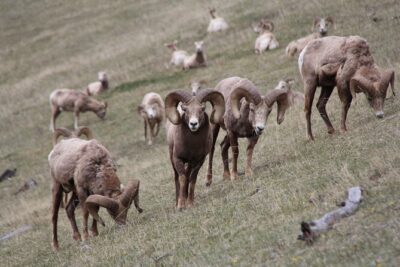 ★ 4.5Banff Highlights & Wildlife | Award-Winning Small Group AdventureFrom $94725 reviews
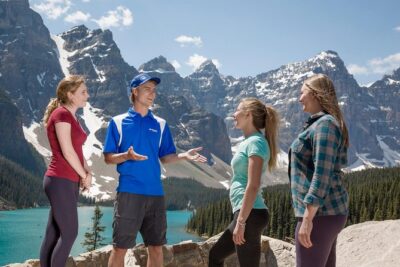 ★ 4.5Banff National Park Tour with Lake Louise and Moraine LakeFrom $119692 reviews
 ★ 5.0Discover Banff National Park – Premium Day TripFrom $64682 reviews
 ★ 4.6Banff National Park: 1-Hour Bow River Horseback RideFrom $78518 reviews
 ★ 5.0Calgary/Canmore: Banff National Park & Lake Louise Day TripFrom $86491 reviews
 ★ 4.51 Hour Bow River RideFrom $82429 reviews
Browse the lists this tour appears in